PAP does not have ‘right to rule S’pore indefinitely’; it must renew, serve the people and bring progress: PM Lee
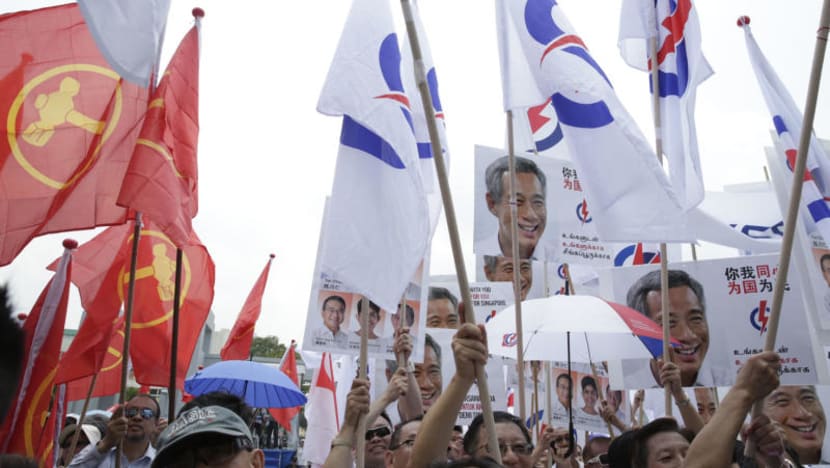
PAP and Workers' Party supporters.


SINGAPORE — The People's Action Party (PAP) does not have the monopoly of power or the right to rule Singapore indefinitely, as the longevity of a political party in government depends on its ability to "renew itself, continue to serve the people, and bring progress to the nation", said Prime Minister Lee Hsien Loong in Parliament on Wednesday (May 16).
Mr Lee devoted part of his speech for the debate on the President's Address to constructive politics and good leadership. He said: "If the PAP can keep on successfully doing that, we can stay in government. But if we ever fail, we deserve to lose."
Even as he urged the PAP Members of Parliament (MPs) to "work hard, serve the people, hold the ground, win the elections", he said this does not mean that the Government will shy away from difficult problems.
"A government must govern. And if ministers are not prepared to govern, then give it up because that's your duty, that's what you are here for," he added.





Governing, he said, means having to do difficult things from time to time because they are necessary. Leadership also means office holders will have to explain, persuade and convince people that they know what they are doing, that it is being done for a good reason, and that it is the right thing to do.
Taking the "hot issue" of Goods and Services Tax (GST) in the recent Malaysian election as an example, Mr Lee noted that Malaysians had linked the GST, which was economically better than the previous sales tax it replaced, with other complaints they had against the previous government.
However, Mr Lee questioned if that meant no government should ever raise taxes, as he said "that is not the real world".
Countries will have no choice but to raise taxes from time to time if revenues are insufficient to cover increasing costs for healthcare, defence, education and other expenses, he said.
Mr Lee added: "Then the government must convince the population that it is raising taxes for a good reason, for the right reason. And whether the voters accept that will depend not just on the arguments, but also crucially on whether they trust the government."
It is also important for voters to trust the Government to do the right thing even when it is painful, said Mr Lee, and that without trust, "politics becomes nothing but the art of pandering – a bidding war between the parties", and that the country will go "downhill".
It is also important to have new leaders for and from each generation, as each generation has to tackle its own set of challenges and make tough decisions.
The ruling party's fourth-generation (4G) leaders are now in place while the opposition Workers' Party (WP) is also going through a leadership transition. The WP elected their new chief Pritam Singh last month, succeeding Mr Low Thia Khiang, who had held the post since 2001.
Sharing the conversation he had with Mr Low at the reopening of Parliament last week, Mr Lee had asked him what would change in the WP with a new leader at the helm.
"(Mr Low said) 'We, the WP, have our role, these things should not change suddenly, don't you agree? I agreed with Mr Low," said Mr Lee.
Noting that opposition parties "keep Singapore politics contestable", the prime minister added that WP plays a role in the political system regardless of who their party leader is.
Likewise, PAP "does not have a monopoly of power, does not have the right to rule Singapore indefinitely". He also noted that political parties do not have a fixed lifespan that specifies when it lives and dies.
As long as the PAP government performs, it will keep the voters' support and stay in power, and the opposition cannot gain ground. But if the PAP government becomes incompetent or corrupt, the opposition will grow, he said.
Mr Lee added: "So our system gives the PAP government, gives any government, every incentive to perform, and to keep the opposition performing its role where it is, namely in the opposition."