Peritoneal dialysis: A gentler treatment process for kidney patients
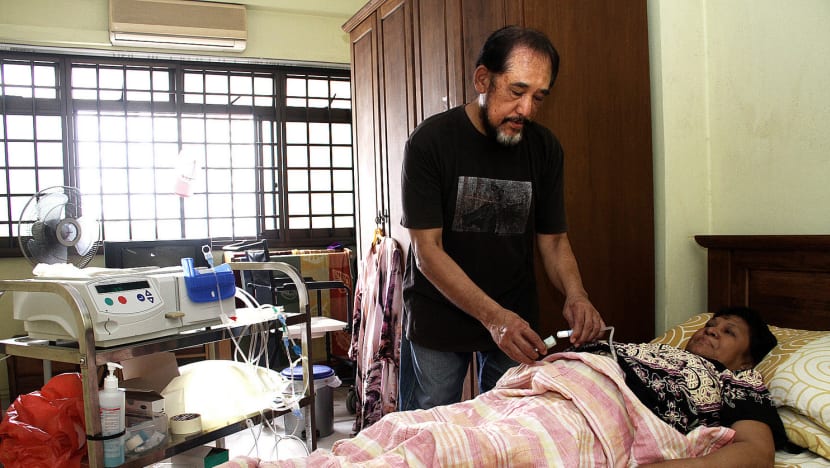
Mr Yassin Buang helping his wife Sarbanon hook up to the peritoneal dialysis machine. Photo: Robin Choo
SINGAPORE — Before going to bed, Madam Sarbanon Buang, 63, hooks herself up to a dialysis machine, which draws out waste that has collected in her body during the day and injects a fresh supply of a glucose solution.
The procedure, carried out with the help of her husband and caregiver Yassin Buang, is repeated several times over a 10-hour period nightly, leaving Mdm Sarbanon free in the day to go about her daily activities.
Mdm Sarbanon is among the relatively few kidney patients in Singapore who choose to take up peritoneal dialysis (PD), which can be done at home, but is shunned by many patients due to concerns about having to perform the procedure by themselves.
This is despite the fact that PD has many advantages — it is a gentler treatment process that lessens the burden on the kidney, said medical professionals.





The take-up rate for the procedure remains low, at about 330 patients as of June last year — compared with close to 3,000 on blood dialysis or hemodialysis (HD), said the National Kidney Foundation (NKF).
Asked how the foundation would expand on its outreach for PD, senior nurse clinician Tang Woon Hoe said: “We are working in this area, to slowly introduce PD to all nursing homes in Singapore. As the whole nation ages, I think the nursing home is one facility people will require. We also foresee that more of our PD patients may need nursing homes, so we are also looking at that.”
The NKF, which plans to raise subsidies for PD, will be carrying out more activities to increase public awareness of the procedure, such as a carnival to mark World Kidney Day, to be held on March 14 and 15 at the National Library on Victoria Street.
Dr Adrian Liew, Tan Tock Seng Hospital’s head of the renal medicine department, said one way to reduce apprehensions about PD is to get patients to interact with those who use the procedure, so they get a better understanding of the treatment.
Doctors whom TODAY interviewed pointed out that PD offered users a wide range of benefits.
Dr Marjorie Foo, who heads Singapore General Hospital’s department of renal medicine, cited the treatment’s gentleness as an important factor.
“The continuous and slow efficient nature of the treatment allows for body waste to be removed at a constant rate like the kidney. In patients where heart disease is present, this treatment will not aggravate or accelerate heart conditions,” she said.
PD also need not be conducted in extremely sterile conditions. “It is not necessary to have a sink in the exchange area (where the procedure is carried out) or air conditioning, as long as the room is dust-free or windows are closed during the exchange,” Dr Foo added.
Infections, if any, are usually not life-threatening and can be treated through prescribed antibiotics as an outpatient case.
National University Hospital’s head of nephrology division, Professor A Vathsala, said that while HD patients may experience an infection after about 30 months, PD patients are more likely to experience such an episode after about 60 months.
“This does not mean that every patient on PD will get an infection after 60 months. Infections, in general, are fewer with PD than HD,” she said.
Mdm Sarbanon’s husband said the home-based treatment gets easier with practice.
“In the beginning, I always make mistakes. Every night, I had to call Baxter (the vendor supplying the PD cycler) for help. But I have become more confident now,” said Mr Yassin, 65.