Populist politics seen in US could happen in S'pore if public dissatisfaction is unresolved: PM Lee
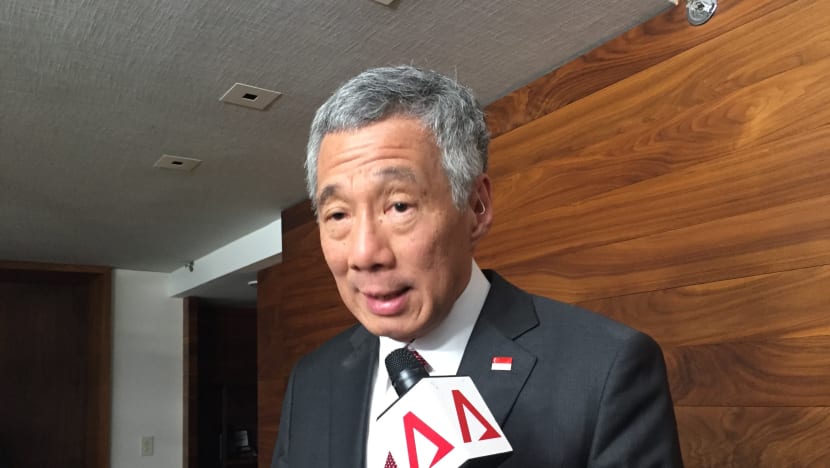
Prime Minister Lee Hsien Loong speaking to the media in Washington. Photo: Lin Yanqin
WASHINGTON — American politics have become dominated by candidates using extremist views to play to people’s anxiety. And this kind of politics could happen in Singapore, or other countries for that matter, if citizens’ unhappiness are not addressed, said Prime Minister Lee Hsien Loong.
Wrapping up his week-long visit to the United States this morning (Singapore time), Mr Lee – whose visit included meetings with Federal Reserve chair Janet Yellen and former New York City mayor Michael Bloomberg – told the Singapore media that the mood in the US is very “troubled”.
The sentiment over the Trans-Pacific Partnership (TPP) – whose ratification by the US Congress looks set to be delayed – is an example of how populist politics could have a global impact. “Even if you are for free trade in this mood in America, you will not want to act on it and give your opponent an extra stone to throw at you,” said Mr Lee.
In such a mood, it is not easy to make a case on why “a complicated agreement (which is) 1,000 pages long is good for America”. “It’s much easier for people to raise anxieties and negatives and sour the public support,” said Mr Lee.





He noted that ratification of the trade deal involving 12 countries – including Singapore – was unlikely to happen before January. Even after that, much would depend on the outcome of the US Presidential Election – which will be held in November – and who will be the majority in the US Congress and Senate, he said. Should the US become less engaged globally as a result of being preoccupied with domestic politics, this would have implications for the whole world, said Mr Lee, reiterating that the US plays an indispensable role in Asia, be it in security or economically.
While big countries will “somehow get through” if the American pillar is shaken, small countries such as Singapore will have a “very rough ride”, said Mr Lee.
The US is one of Singapore’s biggest export markets. “If they are not as open, if they are not as predictable, if they say ‘no… the Koreans and the Japanese ought to go build up their own nuclear weapons and they should pay us for defending them’, it’s a completely different world,” he said. “The Americans take the long view, and say they’ve had ups and downs and after a difficult time it stabilises, but the difficult times may be two terms, maybe longer, and a lot of things can happen during those two terms.”
The type of politics being played out in the US is also happening elsewhere in the world, Mr Lee said. It happens when a population is feeling unsettled and angry, and that the existing political leadership and process are not addressing these emotions, he added. “These are pressures which build up and they could build up in Singapore because, as a developed economy, we face some of the same challenges as they do,” he said. “And if we are unable to address that, people will feel like there is no other avenue to have their concerns seen to and their feelings spoken for.”
Singaporeans, he said, must never believe they are in a “magic state” where the problems seen elsewhere will not happen in Singapore. “What we can say is these are problems in other countries, we must work very hard to avoid them coming to Singapore,” he added.
Singapore recently held its General Election in September last year, which the People’s Action Party (PAP) won with a landslide. A by-election in Bukit Batok is imminent, after former PAP Member of Parliament David Ong resigned over an alleged extramarital affair. Mr Lee was tight-lipped on the date of the by-election. “When it happens, you will know,” he said.
Mr Lee’s visit to the US began in New York City, where he met Mr Bloomberg and former US Secretary of State Henry Kissinger, and ended in Washington DC where he attended the final Nuclear Security Summit hosted by US President Barack Obama.
The summit was first held in 2010, initiated by Mr Obama to get countries to commit to denuclearisation and improving nuclear security. Mr Lee, who had spoken about the threat of nuclear terrorism by groups such as the Islamic State (IS) at the event, noted that countries were taking the issue seriously. “In fact, we spent the last session this afternoon talking about terrorism rather than talking about nuclear issues,” he said.
Although terrorists operating in Southeast Asia are unlikely to be in possession of nuclear material, using a nuclear weapon is already a scenario floated by IS in the Middle East.
Singapore, Mr Lee said, cannot ignore the problem simply because it is not a pressing one in the region. As a global trans-shipment hub, Singapore must be able to detect and intercept nuclear materials passing through when necessary, he added.
While the nuclear power plants being proposed by neighbouring countries do not pose security issues, there are risks of sabotage and theft. “That’s why we are building up our capabilities to understand nuclear safety and that’s why we participate in conferences like this because the security part requires international cooperation,” Mr Lee said.
During the summit, Mr Lee also had bilateral meetings on the sidelines with Malaysia, Australia, Israel, Denmark, the Netherlands and Thailand. Thai Prime Minister Prayut Chan-o-cha has accepted an invitation to deliver the keynote speech at the Shangri-la Dialogue later this year, Singapore’s Prime Minister’s Office said.