Protecting multiracialism critical in fight against terror: Shanmugam
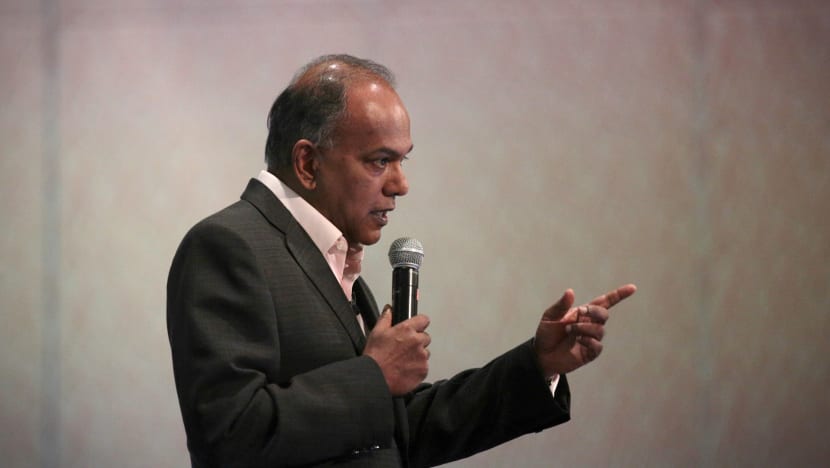
TODAY file photo


SINGAPORE — Laws and legal options to deal with segregationist teachings and hate speech are being reviewed to counter the threat to the hard-earned multiracialism in Singapore posed by terrorism, Home Affairs Minister K Shanmugam said on Tuesday (Oct 3).
One area being looked at is further tightening the access to a local audience by foreign preachers who do not share the Republic’s views of religious harmony, he added.
Mr Shanmugam was speaking in Parliament during a private member’s motion on staying united against the terrorism threat.
Four backbenchers — Mr Christopher de Souza, Dr Intan Azura Mokhtar, Mr Murali Pillai, and Dr Tan Wu Meng — called on the House to fortify Singapore’s resolve to stay united amid the terror threat by reaffirming multiracialism and social cohesion. In total, 17 Members of Parliament rose to speak in the debate, including Mr Shanmugam and Minister-in-charge of Muslim Affairs Yaacob Ibrahim.





In a speech lasting nearly one hour, Mr Shanmugam reiterated that while Singapore has gained some success in building up multiracialism in Singapore, it remains a work in progress — a message government leaders, including Prime Minister Lee Hsien Loong and Deputy Prime Minister Teo Chee Hean, have touched on in recent weeks.
He also traced the types of terror threats Singapore is facing, how the authorities have responded, and what else the Government plans to do.
Over and above beefing up security agencies’ ability to respond and preparing the community on what to do in the event of a terror attack, protecting and preserving Singapore’s multiracialism is key, Mr Shanmugam stressed.
One way to achieve that is to keep foreign preachers who do not share Singapore’s values of religious harmony at bay, as has been done recently, with Muslim and Christian preachers. While an open society like Singapore’s cannot avoid being influenced by external developments, it still must try its best to insulate itself from overseas events and foreign doctrines that can “do us serious harm”, he noted.
During his speech, he played two video clips to illustrate why such preachers cannot be allowed in. One was of Mufti Menk — banned from Singapore two years ago — who preached that Muslims would be sinning if they wished non-Muslims Merry Christmas or Happy Deepavali.
“This is dangerous. Divisive. Our common spaces will shrink and different segments of the community will drift apart,” he said.
Mr Shanmugam said the authorities are studying how to tighten the process to ensure that such preachers do not come into Singapore.
“We need to draw a clear line between what is acceptable and what is not acceptable. We have to develop our own style in the practice of religion, situation within the context of our multi-religious, multi-racial society,” he said. “Mixing of religion and politics is another dangerous area. We need to guard against that, because that is happening quite a bit around the region.”
He also noted that social media emboldens hate speech; something which several MPs noted have the potential to inflame emotions.
While Singapore has used laws against hate speech, the authorities are looking at whether they need to move more quickly or have more options to deal with this appropriately and decisively, added Mr Shanmugam, who is also Law Minister.
The Government is also reviewing the Maintenance of Religious Harmony Act to see how best to deal with segregationist teachings.
Mr Shanmugam said: “Religion can be and has been a source of strength to our society, but we must also watch for exclusivist, intolerant practices because that can deepen fault lines and weaken our entire society.”
The authorities will also study suggestions, such as the building of an Islamic College, which Dr Yaacob raised during his speech. This college can train a new generation of religious teachers who understand Singapore’s multi-religious and multi-racial context, he said.
Dr Yaacob, who is also Minister for Communications and Information, had said earlier that the Malay-Muslim community recognises the threat of extremist ideology, segregationist beliefs and practices and Islamophobia. The community has also taken measures to address with them, including making the Asatizah Recognition Scheme mandatory, where all existing and aspiring asatizah and Islamic Education Centres and Providers will must register with the board before they can teach Islam in Singapore.
Elaborating on the importance of reaffirming Singapore’s fundamental principle of multiracialism, Mr Shanmugam harked back to founding Prime Minister Lee Kuan Yew’s vision of a multi-racial nation for Singapore during its independence. He noted that while this is not yet a perfect reality, Singapore is on the right path, compared with many countries that have found that fault lines are difficult to deal with.
The challenges of terrorism, radicalization and extremism today will have to be met with the same dedication and resolve, he stressed.
He said it would be challenging to achieve pioneer leader S Rajaratnam’s vision of a “homogenous race of Singaporeans” in the near term. Instead, Singapore can realistically achieve a strong national identity that will overlay the separate racial and religious identities, he added.
Singapore, noted Mr Shanmugam, never believed that a laissez faire approach in creating a national identity, a multi-racial society, would work.
“We were activists in this respect. We have had an activist policy of fostering inter-religious and inter-racial harmony,” he said, citing the Ethnic Integration Policy in the Housing and Development Board estates, national schools system using English as the medium of instruction and National Service as examples.
“In fact, we are often accused of being too interventionist and too focused on race. I don’t think one can be too interventionist in this context,” he added, comparing the situation of free speech in the United Kingdom and attempts at creating a multicultural society in Germany.
“Other countries’ experience reminds us that we have to continue to build on the strong foundations that our country has had and we have to continue to be activist,” he added.
Amid threats from world and regional events, the release of radicalised prisoners, the self-radicalisation of individuals and divisive teachings, Mr Shanmugam also spoke about how Singapore has responded thus far.
Among them was the SGSecure movement, launched last year, which aims to train and mobilise people to help prevent and deal with a terror attack. Nearly 1 million devices have downloaded the SGSecure app and officers have spoken to more than 220,000 households within a year.
Among other measures, the MHA and Ministry of Communications and Information are engaging “high profile influencers” to reach out to difference segments of the community when an attack happens.
Concluding his speech, Mr Shanmugam said Singapore’s approach was to build a Singapore identity that can accommodate diversity. This is an “ongoing journey” that requires continuous adjustments and refinements to cater to evolving circumstances here and abroad.
“Terrorism is not a threat that will go away anytime soon. It threatens our very existence as one of the most religiously diverse and harmonious societies in the world, where different religious faiths have been able to co-exist peacefully,” he said. “We must resolve never to allow that, and maintain the previous harmony that we have here.”