Public monies have been lost, minister charges
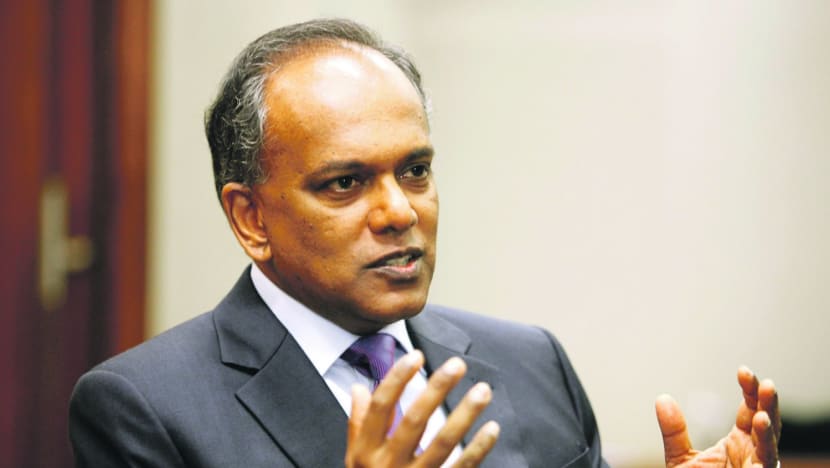
Mr K Shanmugam, Minister for Foreign Affairs and Minister for Law. Photo: Reuters


SINGAPORE — Aljunied-Hougang-Punggol East Town Council’s (AHPETC) transactions with its managing agent and a vendor, which its senior staff have stakes in, are “unlawful” and the Workers’ Party (WP) Members of Parliament (MPs) have seriously breached their fiduciary duties in allowing the arrangement, charged Law and Foreign Minister K Shanmugam yesterday.
The minister made these points at the end of a nearly four-hour debate on the motion raised on the Auditor-General’s Office (AGO) findings on the town council, which was kicked off with National Development Minister Khaw Boon Wan flagging the implications that the WP’s less-than-stellar running of the AHPETC would have for residents.
The AGO’s findings, made public on Monday, highlighted five major lapses, but Mr Shanmugam dedicated his entire speech yesterday to only one of them: Related party transactions the town council was involved in.
How did it come to be that four senior staff at the AHPETC had ownership interests in the constituency’s managing agent and another vendor, leading to them essentially billing and approving payments to themselves, he asked, zeroing in on the WP town councillors’ intentions behind concealing details of and sanctioning these deals.





Despite the WP’s denials, public monies have been lost by their actions, said Mr Shanmugam, who made it a point to stress that the funds were the “hard-earned money” of residents in the opposition ward.
“The rhetoric from the WP is always about helping the poor man. The reality is that the WP took money from the man in the street and gave it to FMSS,” the minister said, referring to FM Solutions and Services, which was started by a husband-and-wife team who are “hardcore WP supporters”.
In Financial Year 2012/13, which was the subject of audit by the AGO, 84 cheques totalling S$6.6 million were paid out by AHPETC to FMSS and FM Solutions and Integrated Services, another firm linked to AHPETC staff, he pointed out.
The sum would be much larger when measured across the span of time since the WP took over the management of the constituency in 2011, he added. “The payments they were verifying and approving on behalf of the town council were going into their own pockets. This is not a theoretical conflict of interest. It is real conflict,” said Mr Shanmugam.
“No town councillor who knew these facts should have approved this structure,” he added, as this is “unlawful” — a word he used no fewer than 10 times in a 45-minute speech.
“And it would have been a serious breach of fiduciary duties for any town councillor to have approved such a process.”
He went further to charge that such an arrangement was designed. “FMSS was a convenient vehicle to which millions of dollars went from the town council. And another obvious question: Money that went to FMSS — where did it actually go? What happened to it?”
More losses came in the form of overcharging, Mr Shanmugam added, flagging the higher managing agent fees FMSS charged compared with those in other town councils.
He cited a fee proposal from FMSS to provide essential services as an example, where the town councillors approved a bill that was S$120,000 higher than the previous service provider’s — a situation that arose out of mistakes, AHPETC explained.
But Mr Shanmugam attacked this, asking how the mistake could have arisen and on how many other instances mistakes had benefited FMSS. “Who knows? This particular case of overcharging was exposed quite by chance. If not exposed, the money would not have been repaid,” said Mr Shanmugam, who noted that the AGO had not been asked to do a forensic audit — suggesting that more could have been uncovered.
Questions on the extent to which each town councillor knew of FMSS’ ownership structure and AHPETC’s payment mode to it also needed to be asked, said Mr Shanmugam.
There was no record in the town council’s discussions about the conflict of interests, flawed payment process and safeguards needed, he said. When auditors, including its own, asked about it, AHPETC chose instead to evade them.
“Why doesn’t the town council give proper answers instead of playing hide-and-seek? What are you hiding?” he asked. “That is not negligence. It is an active decision to suppress. It raises the issue of integrity. The issue of integrity is raised right through.”
Disclosures of such related party transactions are also required in financial statements, in line with financial reporting standards, said the minister.
“The law takes an extremely strict view on related party transactions (and) on conflicts of interests. Where contracts have been entered into with related parties in breach of fiduciary duties, the law presumes loss,” he said.
“Given all of this, how can Ms Lim or anyone say, honestly, that no money has been lost? And the money was lost not through accident. The structure was approved by at least some of the town councillors.”
Other WP MPs — Mr Muhamad Faisal Abdul Manap and Mr Chen Show Mao — were also among the eight MPs who spoke yesterday, as charts and figures were trotted out by several of them to support their arguments.
Temperatures rose when Mr Shanmugam took four WP MPs to task individually over their culpability in allowing the related party transactions to happen under their noses, as an inaudible off-mike remark irked the minister.
“I beg your pardon, ‘Is that right?’ I am sure we will have your answers to all the questions we have raised. And I am sure that is the most parliamentary language you can find,” he said.
The debate continues today.