Redeployment key to coping with gloomy economic outlook: PM Lee
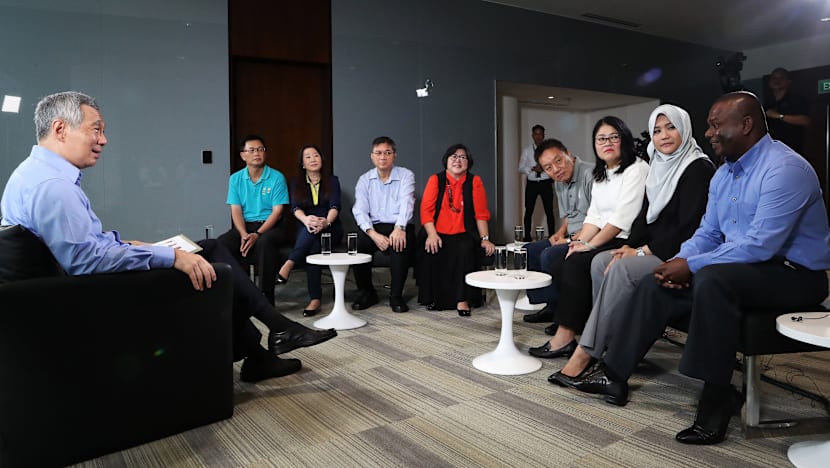
PM Lee Hsien Loong and eight union leaders had a discussion on their industries’ prospects, where the jobs are, the challenges and how they were helping their employees adapt to the restructuring and new job opportunities. Photo: MCI


SINGAPORE — A discussion Prime Minister Lee Hsien Loong had recently with several union leaders — about the prospects for various industries, where the jobs are and how unions were helping workers adapt to restructuring — has highlighted the uneven performances across different sectors.
Among the sectors on an uptick is the hotel industry, with hotels still enjoying high occupancy rates of about 80 per cent, said Mr Tan Hock Soon, vice-president of the NTUC Central Committee and general secretary of the Food, Drinks and Allied Workers Union.
But with margins being squeezed owing to supply and demand forces, and workers’ bonuses “not as good as before” or remaining about the same, workers must upgrade themselves to stay relevant, he said.
The chemicals industry is also doing well, with new jobs still being created, noted Mr Lee during the discussion on April 18, the video recording and transcript of which were released on Sunday (April 30) by the Prime Minister’s Office.





Pioneering companies such as Shell and Esso are still around, while chemical manufacturer Evonik is set to bring in another 150 engineering jobs with their investment in a new plant, said United Workers of Petroleum Industry assistant general secretary Ho Shiong Yee.
But amid a landscape of future restructuring and consolidation, some workers, especially professionals, managers, executives and technicians, might find it a struggle to cope, said Mr Lee.
To overcome this challenge, company managements should work together with the unions to prepare their workers in advance to retrain and upgrade their skill sets for a second career, said Ms Ho.
One industry seeing a downturn is the offshore and marine sector, where workers might be able to enjoy 12 months’ bonus or none at all, noted Mr Lee.
Acknowledging the “painful situation”, Shipbuilding and Marine Engineering Employees’ Union executive secretary Mah Cheong Fatt cited how the industry has shed about 30,000 to 40,000 jobs overseas and locally, including sub-contractors, over the last two years.
Additionally, the unionised companies have retrenched about 1,500 workers, while another 460 employees aged 62 years and above were retired and not offered reemployment, he said. Repair jobs are also “hard to come by”, and Mr Mah expects another few hundred to be retrenched.
Mr Lee said that for such workers to cope with this gloomy outlook, the first priority is to help them locate other jobs in sectors like aerospace, which is still hiring people with similar skills, like engineers.
But beyond redeploying workers between industries — such as from offshore to aerospace — Mr Lee also stressed on redeploying people within the industries, such as the financial services sector which now employs more people but also needs “different skills than before.”
Even within a fast-changing sector like financial services, jobs must be re-engineered and redesigned amid digital transformation, said Singapore Industrial and Services Employees’ Union executive secretary Sylvia Choo.
Banks are still seeing growth areas and niches like wealth management, cybersecurity, fintech and compliance, said Ms Choo, who is also NTUC’s Financial & Business Services Cluster supervising lead.
Hence, the unions and employers are working to see how they can modify on-the-job training for workers.
One industry that is doing well is the port industry as it bounces back from tough times, said Mr Lee.
Metal Industries Workers’ Union and Singapore Port Workers Union executive secretary Jessie Yeo added that the sector has also benefited from growth in recent years. After a consolidation period, when 520 workers were transferred to terminals away from the city area, the sector now faces a new set of problems.
“The workers are a lot happier now. It’s a different set of problems now — it’s a happy problem now. They’re worried about being so busy. Would fatigue set in later on?” said Ms Yeo.