Robotic sock helps prevent deep vein thrombosis
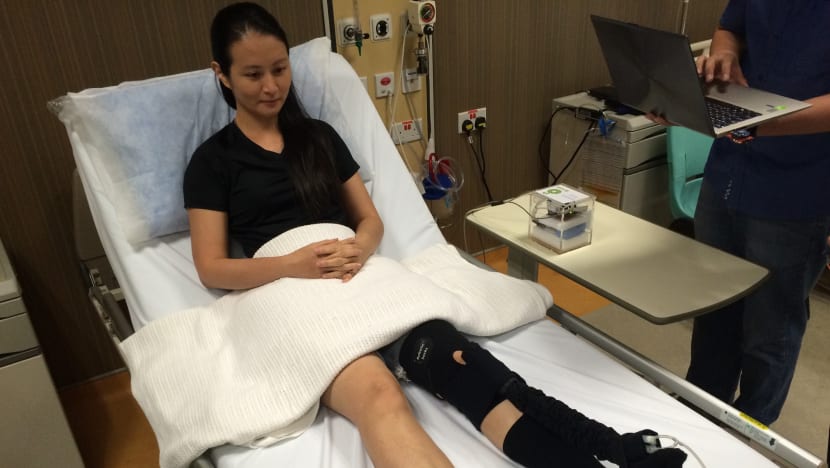
Dr Liu Yuchun, a member of the research team from the National University of Singapore's Yong Loo Lin School of Medicine and Faculty of Engineering, demonstrating the use of the robotic sock. Photo: Matthias Tay
SINGAPORE — Researchers from the National University of Singapore (NUS) are hoping their latest invention, a robotic sock, will lower the risk of bedridden patients developing deep vein thrombosis (DVT), a condition that usually occurs when the body stays in a stationary position for prolonged periods.
The sock, which is made of silicon, exercises a patient’s lower leg to stimulate blood circulation. It was invented by a team of researchers from the university’s Yong Loo Lin School of Medicine and Faculty of Engineering to help prevent patients with mobility problems from getting DVT, in which a blood clot forms, usually in the lower leg or thigh, and can break off and travel through the bloodstream to areas such as the lung and brain, resulting in severe damage or even death.
Assistant Professor Raye Yeow Chen Hua from the NUS Department of Biomedical Engineering said between 10 and 30 per cent of DVT sufferers die within a month of diagnosis. The condition causes up to 800,000 deaths per year worldwide. “If you work out the maths, it is about one death every minute,” said Dr Yeow.
Other members on the team include Assistant Professor Lim Jeong Hoon from the NUS Department of Medicine and first-year PhD candidate in biomedical engineering Low Fanzhe.





The sock will be piloted among patients from the National University Hospital next month.
“The pilot clinical trial will allow us to establish the efficacy of this robotic sock and upon the completion of this trial, we will gather feedback from the patients, caregivers and doctors on how we can further improve and refine the design, and improve on the capabilities,” said Dr Yeow.
The robotic sock simulates ankle exercises that complement physiotherapy to help in the recovery process. This keeps the lower leg muscles active and promotes blood circulation.
The current model can be operated only with a computer and needs to be connected to a power outlet. The team is trying to get it to work wirelessly with a remote control and increase the number of movements the sock can perform to simulate physiotherapy.
Dr Yeow noted that existing remedies for DVT often led to undesirable side effects or did little to improve the patient’s condition. For example, commonly used anti-coagulant medication increased the risk of excessive bleeding, while clinical reports on other preventive measures, such as compression stockings, showed that such treatments were largely ineffective.
“Given its compact size, modular design and ease of use, the soft robotic sock can be adopted in hospital wards and rehabilitation centres for on-bed applications to prevent DVT among stroke patients or even at home for bedridden patients,” said Dr Yeow.