Scheme could nudge firms to create ‘transformational change’ for industries
Manpower Minister Lim Swee Say speaks during a media session on August 19, 2015. Photo: Jason Quah


SINGAPORE — Companies and business associations yesterday welcomed the new scheme that they felt answered the cries for help from small and medium enterprises (SMEs) struggling to transform their business models in the current challenging climate.
The scheme could nudge business owners to dig deep and come up with ideas to create “transformational change” for their respective industries, they added.
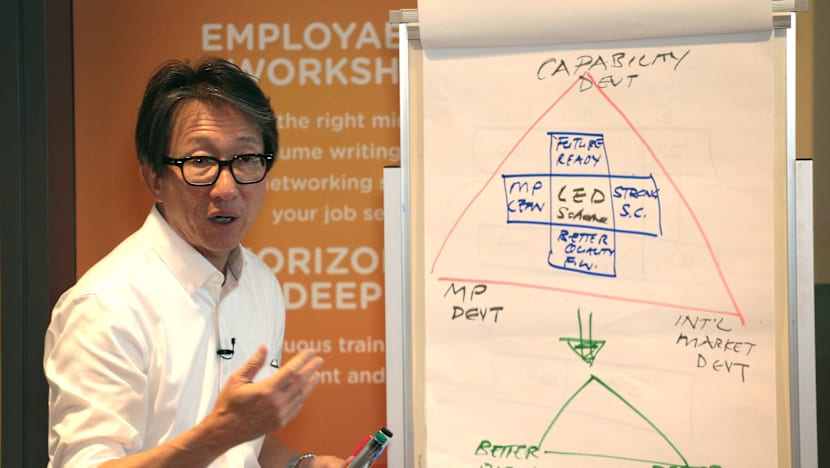
Under the Lean Enterprise Development (LED) scheme, SMEs are granted more flexibility in hiring and retaining foreign workers if they commit to becoming more manpower-lean, developing their workers, and building a stronger Singaporean core eventually.
Companies described it as a respite for them, especially for those in industries that are finding it difficult to attract Singaporeans.





Mr Chan Tai Pang, chief executive officer of Systematic Laundry and Healthcare Services, said: “(Laundry) is not a feasible job for locals, for sure. Now we’ll have the chance to find foreign workers (temporarily) ... We’re already looking at coming up with new business models.”
One idea, which he plans to roll out by the first quarter of next year, is a laundry service in condominiums, where customers could deposit their soiled laundry in a machine using radio frequency identification technology. His workers would collect the laundry, and deliver it to the customers’ doorstep after it is washed.
Currently, his workers go to the residents’ homes to collect the laundry. However, they make wasted trips when no one is at home, he said.
PestBusters chief executive Thomas Fernandez said he plans to revamp his pest control business model with the centralisation of operations in a command centre, and the use of drones.
“We’ll be using technology to attract Generation Y,” he said. “While we have the solutions, we also need the foreigners to train our locals temporarily.”
However, he wondered if the new scheme could inadvertently lead to an over-dependence on the interim foreign workers.
Singapore Business Federation (SBF) chief operating officer Victor Tay felt that the time frame of two to three years for firms to transform their business models was appropriate. “But a lot of planning will have to be done because these foreign workers will have to go two to three years later. The companies will have to think of how to let them exit,” said Mr Tay.
SBF chief executive officer Ho Meng Kit said the new scheme strikes a balance between allowing progressive companies to hire foreign workers and keeping the “broader policy of slowing growth of foreign workers”. “On the flip side, the assessing body may face a challenge in determining projects that qualify for the scheme,” he said.
Lauding the initiative, Association of Small and Medium Enterprises (ASME) president Kurt Wee said: “It’s not only the issuing of a policy and saying, ‘You do your best on your own’. (It takes) an operative approach in looking at how to help companies reach their goal.”
Singapore National Employers Federation (SNEF) executive director Koh Juan Kiat described the scheme as very progressive, and said it would benefit both employers and their employees, especially Singaporeans.
“It also addresses the concerns of the SMEs about the rigid implementation of the foreign worker quotas and the time it takes for them to build up their local capabilities,” he said.
He added that SNEF would work with the SMEs among its members to put up proposals to develop manpower-lean enterprises.
“These solutions if approved will also benefit other SMEs later ... so we think the long-term effect can be significant,” he said.