Shangri-La Dialogue helps countries reduce the chances of misunderstanding, miscalculation: Chan Chun Sing
As new domains evolve rapidly, like-minded countries should develop flexible partnerships, forming "coalitions of the able and willing", says Singapore's Defence Minister Chan Chun Sing.
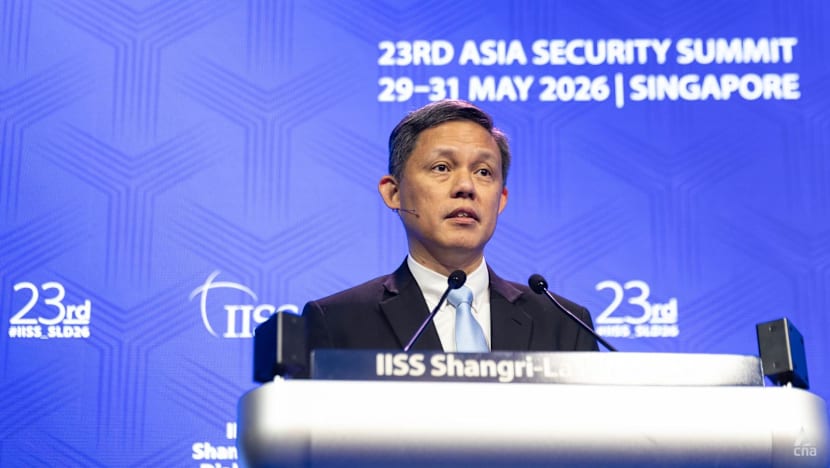
Defence Minister Chan Chun Sing speaks during the sixth plenary session at the 23rd IISS Shangri-La Dialogue on May 31, 2026. (Photo: CNA/Ili Mansor)

This audio is generated by an AI tool.


SINGAPORE: Conferences like the Shangri-La Dialogue allow countries to understand each other's actions and can reduce the chances of misunderstanding and miscalculation, said Singapore's Defence Minister Chan Chun Sing on Sunday (May 31).
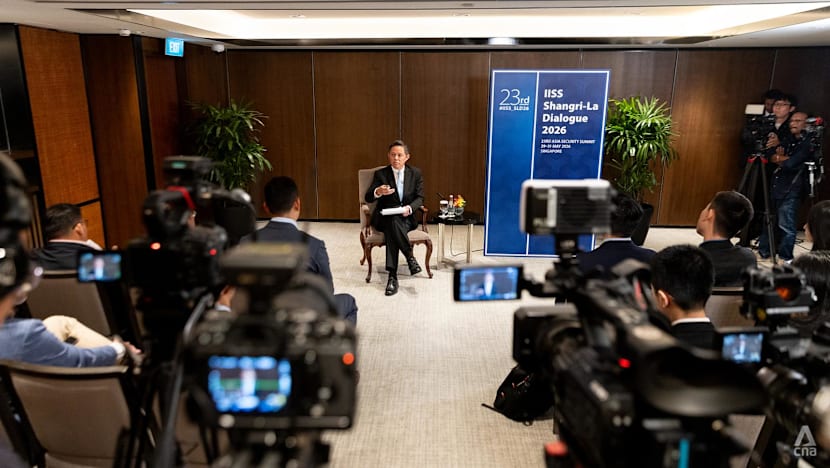
Speaking to reporters in a wrap-up interview, Mr Chan noted that the Shangri-La Dialogue – billed as Asia's premier defence forum – allows countries to check their blind spots and get the chance to see how others are dealing with issues and the lessons they can learn from one another.
"The kind of outcome that we can get from the Shangri-La Dialogue is – again you may not see this – but where countries bilaterally, or perhaps in small groupings, have issues with another party, they are able to talk about it behind closed doors," he said.
"And sometimes when nothing happens on the surface, it is a mark for success, because some of those issues have been better managed or resolved."





The art of defence is to be able to pre-empt issues before they are formed, he added.
Highlighting tangible initiatives that came out of this year's Shangri-La Dialogue, he noted that the Guiding Principles for Underwater Infrastructure Defence Exchanges (GUIDE) framework launched on Saturday stemmed from conversations last year.
The framework was launched by 17 countries, including Singapore, to protect critical underwater infrastructure.
"From those conversations through subsequent bilateral and multilateral conversations, we are able to get so many countries within the last 12 months to come on board to start this initiative," he said.
Mr Chan was also asked about China's participation in this year's Shangri-La Dialogue. China sent a delegation from the People's Liberation Army National Defence University, marking the second straight year Beijing has not opted to send its defence minister.
Mr Chan urged people not to use the phrase "low-level Chinese participation".
"I personally don't like this. I personally don't look down on people and cast them as whether they are low-level or high-level. I think we respect the Chinese participation," he said.
"The Chinese participation will be determined by their own considerations and in different years, they have different levels of participation."
The Chinese delegation has made its presence felt in many of the plenary sessions, Mr Chan said.
Asked about the relationship between China and the United States following a summit between Xi Jinping and Donald Trump earlier this month, Mr Chan said he was happy to see that the meeting between the two presidents had gone well.
"I think it sets the tone for the relationship between the two countries, and I think from this Shangri-La Dialogue, it is quite obvious to all of us observing it, the officials from both sides are following the tone set, and I think this is a good basis for taking the relationship forward," he said.
Noting there are still issues to be resolved, he added: "I think if we approach the challenges ahead with the right attitude, with the collaborative spirit, that speaks well for the chances of us getting to a better outcome than otherwise."
He also addressed questions on defence spending, a point raised by US Defense Secretary Pete Hegseth in his speech on Saturday.
Mr Hegseth had urged Asian allies to ramp up military spending to counter China's growing power and prevent its dominance in the region, adding that the US expects its Asian allies and partners to increase defence spending to 3.5 per cent of gross domestic product (GDP).
Mr Chan said on Sunday that whether it is increasing defence spending or building new capabilities and becoming a more relevant partner, countries must spend the time and effort to reassure others of their intentions.
"The more powerful we are, the more effort we need to spend to reassure others. Because ultimately in the defence sector, people look at not just capabilities, people look at intention," he said.
He added that there was no linear correlation between expenditure and capability.
"Different countries spend different amounts, different countries use their expenditure differently, wisely to build up capabilities according to their needs," he added.
Another topic brought up in the interview was about the Association of Southeast Asian Nations (ASEAN), to which Mr Chan said the bloc "must never be complacent".
"ASEAN must be very clear in our perspective. Where are those challenges today, and where are those challenges tomorrow? We have to deal with not only today's challenges, we have to deal with tomorrow's challenges," he said.

PRINCIPLES, PARTNERSHIPS AND POLITICS
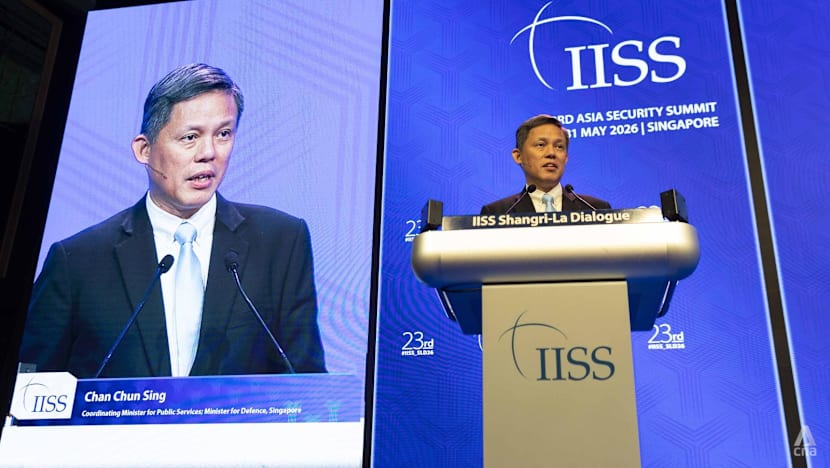
Earlier on Sunday, Mr Chan spoke at a plenary session about evolving security partnerships in a fragmenting world.
Two other speakers - the Philippines' Secretary of National Defense Gilberto Teodoro Jr and the North Atlantic Treaty Organization (NATO) chair of the military committee Admiral Giuseppe Cavo Dragone - were also part of the session.
In his speech, Mr Chan noted that today's conflicts reflect the interplay of multiple dimensions of power, from weaponising economic leverage to contesting narratives.
As conflict evolves, responses must also adapt, he said, suggesting three responses in terms of principles, partnerships and politics.
On principles, Mr Chan said: "We must both maintain and update the rules and norms that are critical to our security and progress. We must not think that we can do without principles, institutions, and norms."
He called for more and new networks of flexible, overlapping issue-based partnerships to address the new challenges.
"We must not think that going alone can better address our insecurities," he said.
On politics, Mr Chan noted that domestic confidence and cohesion are prerequisites for policy continuity, societal coherence, capability development, and in turn, international cooperation.
"We cannot manage international issues without managing domestic issues well, nor can we manage domestic issues well by ignoring international ones."
Expanding on his three suggestions, Mr Chan said that in terms of institutions and norms, the current system needs to be refreshed and aligned with today's realities.
"The alternative, a world with weak institutions and norms, where every issue and every relationship is viewed through a transactional lens, would leave us all worse off," he added.
"More beggar-thy-neighbour policies would make beggars of us all. Heightened uncertainties erode business confidence, deter investments, and ultimately slow growth."
He added that rules and norms are especially critical when they are grounded in international law, citing the United Nations Convention on the Law of the Sea (UNCLOS) as an example.
"It provides clear and firm rules for our maritime activities, including the right of transit passage through critical straits used for international navigation. Keeping our sea lanes open is not just a matter of law, but of enlightened self-interest for all nations. Our survival, trade, and prosperity depend on it," he said.
He pointed to the Strait of Hormuz, a critical chokepoint for global trade that has been disrupted amid the Middle East war.
"Should the right of transit passage be eroded, all countries that depend on maritime connectivity would be worse off. For the sake of global commerce, we must avoid a race to the bottom where states try to price each other out of access to such critical straits," said Mr Chan.
Additionally, as new domains evolve rapidly, there should be flexible partnerships developed with like-minded countries, forming "coalitions of the able and willing", he added.
Some of these new networks must include not just countries but also other stakeholders.
Highlighting the GUIDE framework in his speech on Sunday, Mr Chan said Singapore saw a need to bring together like-minded partners from across different regions to tackle the global and transboundary challenge of critical underwater infrastructure security.
"The value of GUIDE is not only in the principles themselves, but in the network it builds. Through GUIDE, we hope to bring countries together around a shared vulnerability and develop common practices before they are tested by crisis," he added.
On politics, he noted that Singapore's Emeritus Senior Minister Goh Chok Tong had once described the country as a "small speedboat in an open sea" – an image that Mr Chan said still holds.
"We cannot control the sea, but we can certainly keep our boat seaworthy. A captain cannot steer the boat effectively if the crew is divided. If our society is anxious or distrustful, our leaders will have less room to negotiate abroad," said Mr Chan.
He referred to domestic stability and external collaboration as a "double helix" that can and must reinforce each other.
"In these rough seas, steering the boat is not an easy task. It may be tempting to enact simple, populist solutions to earn short-term domestic support. However, over time, such solutions erode trust, deepen divisions, and leave societies less resilient," he said.
"True leadership demands the courage to speak difficult truths, the discipline to take a long-term view, and the conviction to act in the broader interests of our people."
Mr Chan was also asked about the partnerships between ASEAN members and how the bloc's collective security and conflict management can be strengthened.
In response, Mr Chan said: "What should ASEAN always remember? Just one thing, the competition is not among us. The competition is really how we get our act together to compete with the rest of the world and make a positive contribution.
"The world has enough trouble. If ASEAN just stay out of trouble, we will distinguish ourselves."
Addressing the question if ASEAN should be pro-US or pro-China, he said: "I hope this is ASEAN's position – we are not pro-US or anti-US. We are not pro-China or anti-China. We are pro-ASEAN."
FIVE POWER DEFENCE ARRANGEMENTS
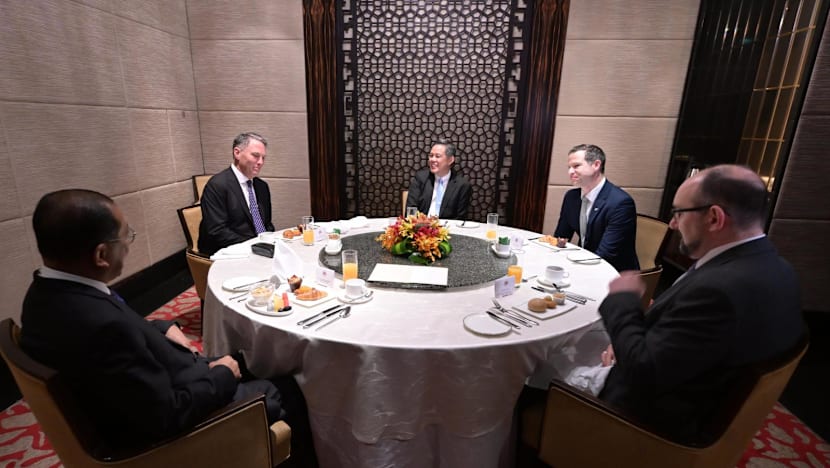
Mr Chan also hosted breakfast on Sunday for the representatives from the Five Power Defence Arrangements (FPDA) member countries.
The session was attended by Australia's Deputy Prime Minister and Minister for Defence Richard Marles, New Zealand's Minister of Defence Chris Penk, Malaysia's Minister of Defence Dato’ Seri Mohamed Khaled Nordin, and the United Kingdom’s Director General (Security Policy) Paul Wyatt.
During breakfast, the representatives reaffirmed their nations’ commitment over the past 55 years. The FPDA – formed in 1971 against the backdrop of armed conflict across Southeast Asia – comprises Singapore, Malaysia, Australia, New Zealand and the UK.
"Over the decades, the FPDA has enhanced interoperability amongst member-nations' militaries in jointly executing large-scale conventional exercises, while evolving to incorporate non-conventional elements such as humanitarian assistance and disaster relief, counter-terrorism, and maritime security," said Singapore's Ministry of Defence in a news release.
The FPDA's regular cadence of professional meetings and exercises provides an important platform for dialogue and exchange of views among member nations, it added.
"The ministers thus affirmed the continued strategic relevance of the FPDA as a constructive, transparent, and peaceful defence arrangement which plays an important role in the regional security architecture," it said.