Singapore investors keep faith in Chinese stock market
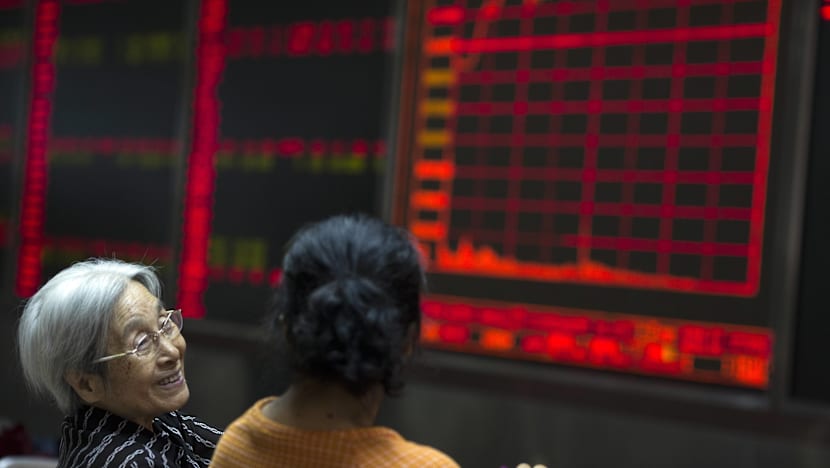
A Chinese stock investor smiles at a brokerage in Beijing, China, Thursday, July 9, 2015. Photo: AP


SINGAPORE — Despite the roller coaster ride this past week, Singapore investors are not bailing out on China’s stock market. Instead, many are choosing to take a moment to catch their breath before heading back into the game.
Following a three-week slide that saw US$3.2 trillion (S$4.32 trillion) wiped off Chinese stocks, frantic efforts by China to stem the sell-off finally began to gain traction on Thursday (July 9) and Friday, going some way towards calming the nerves of investors.
“I sold my shares early, close to a month ago, on my own initiative. However, I still have some shares invested in certain stocks because the market still has trading potential,” said Mr Brans Ong, 41, an entrepreneur.
Mr Ong, who invested one million yuan (S$218,000) in the Chinese stock market about nine months ago, has made about S$100,000 to date.





“I will still watch the market movements and continue to trade once the market cools down slightly,” he said.
Mr John Wong, 38, who is in the finance and consultancy industry, said he pulled his S$50,000 investment from the market several days ago, but intended to continue speculating in the market. “My strategy is to go in and out on a daily basis, because a 5 per cent moment on a daily basis in the volatile market can generate sound returns,” he said, adding that he made a 10 per cent gain on his investments in the Chinese market in two months.
However, Mr Wong said an acquaintance who had not expected the market to recover so quickly suffered a loss of S$50,000 after he panicked and sold his shares last Monday. “He probably will be taking a breather first to recover from the situation.”
Chinese shares bounced back on Thursday and Friday, rising 10 per cent in two days, after a free-fall saw the market slide more than 30 per cent from its mid-June peak earlier last week. On Friday, the Shanghai Composite Index rallied 4.5 per cent, adding to Thursday’s 5.8 per cent surge.
The rebound came after the authorities threw a basket of measures to stem the sell-off, including suspending initial public offerings, enlisting brokers to buy stocks, injecting cash, cutting interest rates, and banning stockholders and executives from selling stakes in listed firms for six months.
Despite the high risks and volatility of the Chinese stock market, analysts and remisiers in Singapore have not closed their doors on Chinese bourses.
“After Friday’s performance, the Chinese market performed its best two-day gain since 2008,” said Mr Bernard Aw, a market analyst at IG. “It is too early to say if this is a rebound into a bull market, but the stronger measures implemented by the regulators are somehow working.”
“In the longer term, the market has growth potential. In the next 12 months, we see the market going up further on a recovery trend, but for now in the next few weeks, market sentiment is more cautious,” said Mr Aw.
He added: “Retail investors make up about 80 per cent of China trade, and that provokes volatility. Unlike more mature stock markets like the United States, which consists of a bigger pool of institutional investors, retail investors tend to follow news trends, rumours and the advice of their brokers. So, there are very high movements and volatility.”
Singaporean investors have increasingly been seeking out alternative countries in which to park their investments, market watchers said, as they lose interest in a lacklustre trading platform at home.
“(These investors) are usually not amateurs, but players who tend to have already started or had experience with the local market first,” said Mr Jimmy Ho, president of the Society of Remisiers (Singapore).
The Straits Times Index ended 0.38 per cent higher at 3,279.88 on Friday, taking the year-to-date performance to -2.53%.