SMU club launches book on S’pore’s electoral process
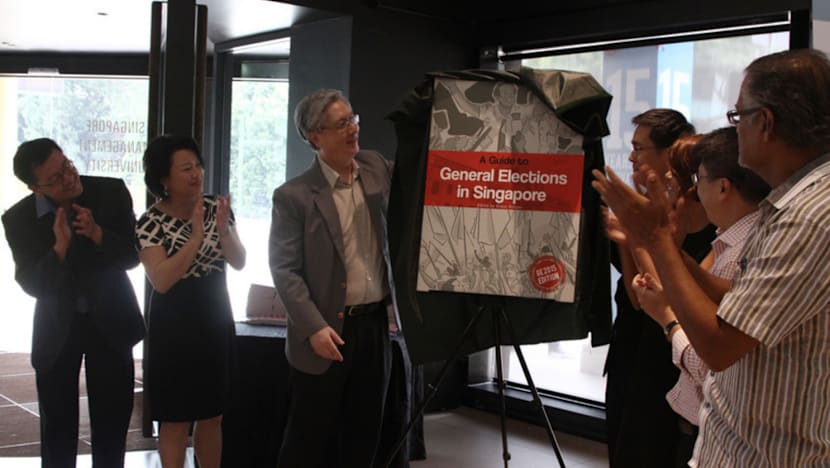
At the launch for the book "A guide to General Elections in Singapore on Aug 31, 2015". Photo: Daryl Kang


SINGAPORE — A guide to the Republic’s electoral process will be made available online this week, ahead of polls next Friday for the country’s 13th government.
The book, titled A Guide to General Elections in Singapore, explains concepts such as the first-past-the-post system adopted by the Republic and discusses topics such as whether votes are kept secret. It also touches on the distinction between the three types of Members of Parliament — fully-elected, Non-Constituency, and Nominated — and outlines the entire electoral process from the dissolution of Parliament to the formation of the Government.
The guide also offers a primer on the 12 political parties here, as well as a recap of the major milestones in Singapore’s electoral history.
It was put together by the Singapore Management University (SMU) Apolitical Club and edited by lawyer Grace Morgan, who is an alumnus of the university’s law faculty.





Speaking at the launch of the book yesterday, Ms Morgan said: “I hope that Singaporeans will see Polling Day as more than a holiday; that this is the time when power returns to the people, and we exercise this choice in the ballots that we cast.”
This is the SMU Apolitical Club’s second publication. In January last year, it launched a book on Singapore’s Constitution.
A panel discussion was also held yesterday as part of the book launch, featuring SMU law academics Eugene Tan and Jack Lee, Institute of Policy Studies senior research fellow Gillian Koh and veteran journalist P N Balji, who is a former editor of TODAY and The New Paper.
During the discussion, Dr Koh said that come Polling Day on Sept 11, voters will be holding the parties accountable to the promises they had made from the previous election. She said: “For the People’s Action Party (PAP), have their (efforts) worked? And has the Workers’ Party (WP) delivered their promises of being a check-and-balance?”
She added that going by recent trends, the younger generation and the better-educated tend to support having a greater Opposition presence in Parliament, as well as take a more “pluralist perspective”.
Mr Balji highlighted the importance of the mainstream media as a credible voice for the Government to use, and acknowledged that there has been greater and more objective news coverage of opposition parties in Singapore.
“But there are new players beginning to occupy the middle space ... It’s a good sign that (websites) like The Middle Ground and Mothership.sg are coming up, but they’re still restricted in terms of resources and putting people on the ground,” he noted.
Mr Balji also questioned the lack of investigative journalism in Singapore, even as he acknowledged that it takes more time and effort to thoroughly research and produce such stories.
On the pace of election season, Associate Professor Tan said: “(It’s a pity) that we’ve not been able to savour SG50 ... and before we could come together, elections are going to get us all worked up together again. But ultimately, it’s not about the PAP or the WP. At the end of it, we should come together as Singaporeans.”