Society ‘far from ready’ to do away with race markers
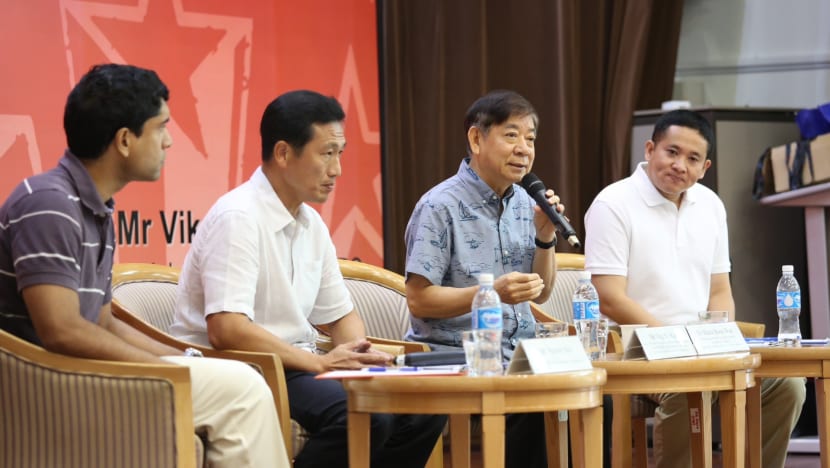
MPs from Sembawang GRC during a Post National Day Rally Dialogue on Sept 11. Photo: People's Association


SINGAPORE — Questions on race relations and whether there was a need to revaluate the CIMO (Chinese, Indians, Malays, Others) model have come up in a post-National Day Rally dialogue even as the proposed changes to the Elected Presidency call for stronger minority representation.
About 120 youth from Sembawang Group Representation Constituency participated in the dialogue hosted on Sunday (Sept 11) by the constituency’s Members of Parliament, who also shared their views on combating terrorism, staying ahead amid a changing economy and pre-emptive policymaking.
Acting Education Minister (Higher Education and Skills) Ong Ye Kung said that with a huge proportion of Singaporeans wanting to be recognised by race, society is “still far from ready” to do away with such identity markers.
And while the youth are becoming increasingly “race blind” and aspiring towards the ideal of scrapping the CIMO, his worry is that they would eventually “forget who they are”.





“What fills our Singaporean identity is these various races, all the traditions, cultures, that we bring forth, that creates this tapestry,” he said.
“From a practical point of view, to accept CIMO is a simplistic, reductive way to remind ourselves we’re multi-cultural ... In the end, it’s the fact that (different races) can have a conversation and talk about things openly, live next to each other, (and study) together that matters.”
When asked how Singaporeans should guard against terror threats, MP and Parliamentary Secretary (Home Affairs) Amrin Amin said it fell on community preparedness, strengthening the defence forces and having resilience and unity.
Saying that the “margin of error” in Singapore is very small, he added: “One gunman isn’t an existential threat in that it would wipe us all out ... but when they plant the seeds of suspicion and hatred among us, that’s the real bomb. We have to make sure we plant the seeds of trust and goodwill among all segments.”
Going forward for Singapore, policymakers must set the direction and be perceptive and pre-emptive, Coordinating Minister for Infrastructure and Transport Minister Khaw Boon Wan said in response to another question, on whether political leaders tended to be more reactive than proactive.
Regarding the influx of investments and people after the economy rebounded from the 2008 financial crisis, and the demand on infrastructure it created, he acknowledged that new train lines required longer time, compared with public housing.
“It’s a long stretch (of time) where many things can happen, and things may not turn out as we planned them ... Inevitably, with supply and demand, there’s always a gap. You cannot fit it perfectly, but we’ll do our best,” he said.
Social media is another “outreach” platform for politicians to get input, MP Vikram Nair said, though he added that it was important for the Government to evaluate the various feedback and make the “right decision”, which might not necessarily reflect popular sentiment.
Agreeing, Mr Ong said it was important for leaders to “master the medium of the day”. He said: “It’s important to engage young people on their turf. If we try to ... lecture, nobody is interested ... But we have to somehow put our message through.”
On the issue of disruptive technology and the “divine discontent” the Prime Minister referred to in his Rally speech, Mr Khaw pointed to examples such as Uber and Grab and said such disruptions could “create opportunities” to think outside the box and innovate.
Beyond technological advancements, there is also a need for “interdisciplinary teaching” to combat challenges ahead, said Mr Ong.
And it is important for Singapore to “have the self-confidence” to chart a different path from other countries, added Mr Khaw, referring to policies such as Electronic Road Pricing and racial quotas in public housing.
“Going forward, as leaders, you might confront such situations where ... there’s a reason for taking a different approach ... If so, have the self-confidence to choose the path,” he urged the youth. “If you can do that, the future’s very bright.”
MINORITY REPRESENTATION CHANGES ‘MUST BE CAREFULLY REVIEWED’
How to ensure minority representation and how the Council of Presidential Advisers (CPA) will shape up were among the topics discussed by youth on Sunday at a post-National Day Rally dialogue at Canberra Community Club.
Mr Darwin Leow, 23, a second-year National University of Singapore student, said that while it was good for minorities to be represented, such changes needed to be “carefully reviewed”.
“A minority (candidate) shouldn’t be (elected for the sake of representation), but should be capable (too). We need more thought and process on how this matrix is going to work out,” he said.
Another NUS student opined that it was important to have a “stronger” President to “represent” the people, and was concerned about the CPA’s powers to override the President in certain scenarios.
She questioned whether having two more CPA members would balance the council or “tilt the scale towards a certain side”. She said: “It’s important for the CPA and President to be on the same page with no internal strife.”