Spur love for lifelong learning in schools, say Nobel laureates
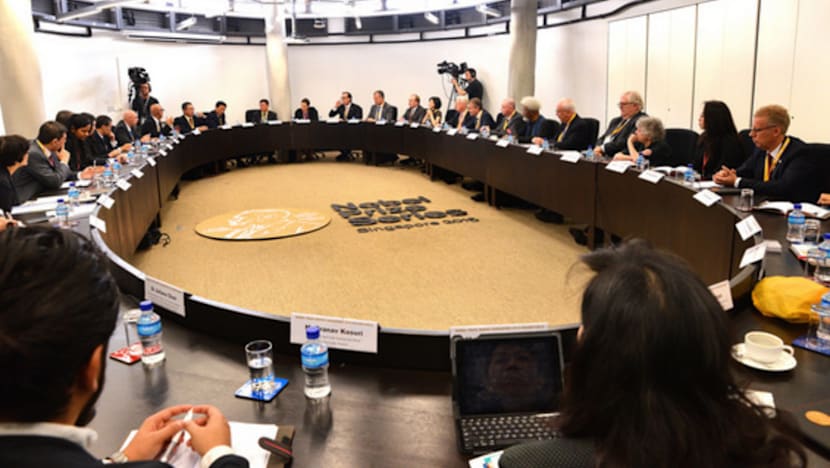
More than 30 of the world’s leading minds, including five Nobel Laureates, scientists, policymakers and thought leaders discussed the future of learning at NTU during the Executive Roundtable of the inaugural Nobel Prize Series Singapore 2015. Photo: NTU


SINGAPORE — Preserving a sense of curiosity, teaching soft skills such as communication and new ways of thinking, and instilling a love for life-long learning: These are some of the traits that should steer the path for the education of tomorrow, said some of the world’s top minds at a round table held yesterday as part of the Nobel Prize Series event.
Five Nobel laureates — among them Professor Stefan Hell (Chemistry, 2014), Sir James Mirrlees (Economic Sciences, 1996) and Professor Wole Soyinka (Literature, 1986) — are in Singapore for the inaugural event, organised by Nanyang Technological University (NTU), the Nobel Media and the Nobel Museum. They took part in the roundtable yesterday, which also included leading scientists, policymakers and thought leaders.
Rapid technological advances, and an “explosion of knowledge” have radically transformed the education landscape, said NTU’s vice-president of education strategies, Professor Lee Sing Kong. It has also brought about a different breed of students — an increasingly wired group thriving on interactive, visual experiences to learn. As such, there is a need to relook at how the curriculum is designed, he said, stressing it needs to continue to build “new attributes and skills”.
One way to do so, said Professor Ada Yonath (Chemistry, 2009), is to imbue the young with a sense of wide-eyed curiosity. Pointing to how children in Singapore take a more passive approach to learning, often relying on their teachers and the Internet for answers, Prof Yonath said they should “keep on learning, to keep asking questions, and try to answer these questions themselves”.





And instead of a system fixated on meeting goals and achievements, they called for a focus on finding joy in the pursuit of knowledge itself. Citing a Confucian philosophy, Sir Harold Kroto (Chemistry, 1996) said: “ Seek not the answer, but understand the question.” Most Nobel prize winners were “accidentally made”, he added.
Others pointed out how being taught philosophy and history would provide a “rich knowledge of the human experience”, while educators should also seek “light the fire” in young minds, and be role models instead of talking down to them.
NTU assistant professor Juliana Chan, noting how Singaporeans take “a very pragmatic approach to learning”, said one way of shifting from a “book-smart” culture to a critical, interdisciplinary mode of thinking would be to enlist in a course where the answers are open-ended. “Only them we can be exposed to a wider variety views, and learn to think critically, creatively, and ethically,” she said.
Industry leaders also pointed out that, first and foremost, graduates need a solid grasp and understanding of knowledge. “One of the frustrations is that though we produce a large pool of graduates — they have soft skills, they can communicate, can network ... but many of them are lacking in intellectual horsepower for the jobs that are required,” said Stamford Law Corporation chairman Lee Suet Fern.
Others questioned if these approaches would shake up the fundamentals of the university model itself, such as whether a graduate would still be relevant in a culture that involves frequent changes in job portfolios.
Entrepreneurship would be a key feature, said Mr Olof Zetterberg, chief executive officer of Stockholm Business Region, pointing out how youths in Sweden who previously wanted to join companies such as Ericsson and IKEA were now starting their own businesses.
Acting Education Minister (Higher Education and Skills) Ong Ye Kung reiterated the need for graduates to not only possess academic knowledge, but also be grounded in soft skills to navigate the future, such as “communication, presentation, networking, intercultural linkages”.
Last week, Deputy Prime Minister Tharman Shanmugaratnam said that children should have the freedom for their minds to “wander” in their growing-up years, and this could mean not having grading and competition “too early in the game”, or not packing the curriculum.
Four public lectures by the Nobel Laureates will be concurrently held today at NTU, the Singapore Management University and the National Gallery Singapore.