Stanford, UC Berkeley among SUTD's new overseas exchange partners
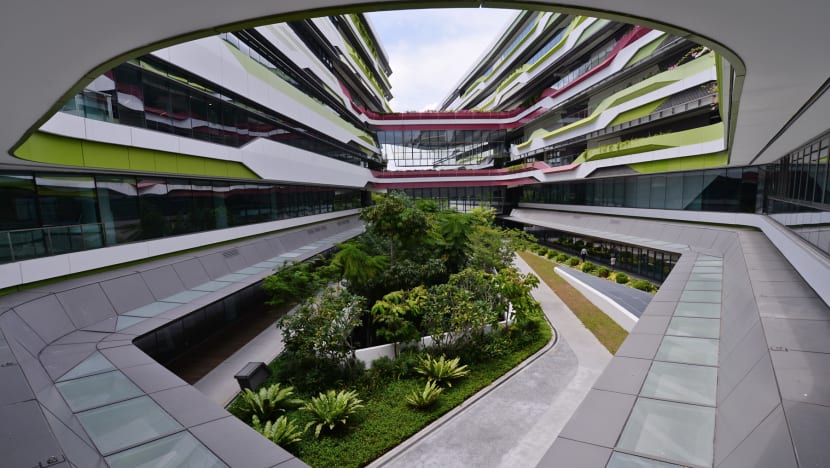
The courtyard of Singapore University of Technology and Design. TODAY file photo


SINGAPORE — The Singapore University of Technology and Design (SUTD) has expanded its overseas exposure programmes by about 40 per cent, which will allow up to three-quarters of each cohort to experience life in varsities, such as Stanford and Berkeley.
From May this year, 80 more overseas placements will be added to SUTD’s offerings for its undergraduates, making up more than 300 places — its yearly cohort averages 350. Besides Stanford University and University of California, Berkeley, the new places are offered by seven overseas institutions and organisations around Asia, Europe, and Canada.
“We believe that SUTD students first need to experience the world, in order to better the world,” said Professor Yeo Kiat Seng, associate provost for international relations and graduate studies, at a press conference on Tuesday (Feb 23). “We encourage them to venture abroad early, as this will nurture their sensitivities to global happenings and provide them with a good foundation to develop technologies and innovations with real world applications and benefits.”
These programmes could be as short as three weeks or as long as an entire term. Some of these programmes are fully- or partially-funded.





To qualify for these programmes, students have to meet minimum academic requirements. Those who do not meet the mark may still get to go overseas on field trips conducted by faculty members, said Prof Yeo. “Our target is to ensure that all our students have overseas exposure ... regardless of whether they do well,” he said.
One of those who qualified for a partially-funded programme was freshman Aravind Satkunasingam Kandiah, 23, who will spend three weeks in Nice, France this July at the European Innovation Academy, one of SUTD’s new partners.
“You will never be working with purely Singaporeans when you start a global business, so I think it is essential to know how to work with people on the other side of the world — how they think, how they conduct their business, so you will gain a competitive edge,” he said.
When contacted, Ms Bernadette Toh, director of Singapore Management University’s Office of Global Learning, said that there are sufficient places for all students in their eligible years to go on overseas exchange.
A National University of Singapore spokesperson said that “Currently, more than 70 per cent of NUS undergraduates enjoy an overseas experience, with about three in 10 for six months or longer”, in reference to figures of their graduating cohort.
Professor Er Meng Hwa, Nanyang Technological University (NTU) vice-president (international affairs), said that “eight in 10 of NTU’s undergraduate cohort of about 6,000 students will have at least one overseas exposure during the course of their studies”.
He added that NTU sent over 5,300 students abroad on overseas programmes last year.
Corrrection: In an earlier version of this report, we stated that Aravind Satkunasingam Kandiah was an SUTD undergraduate studying information systems technology and design. He plans to study information systems technology and design in the next semester. We apologise for the error. We also stated that there are sufficient vacancies for all current second-year students at SMU to go on overseas exchange. SMU clarified that there are sufficient places for all students in their eligible years to go on overseas exchange.