Take into account ‘actual wealth’ when measuring economic inequality: Nobel laureate
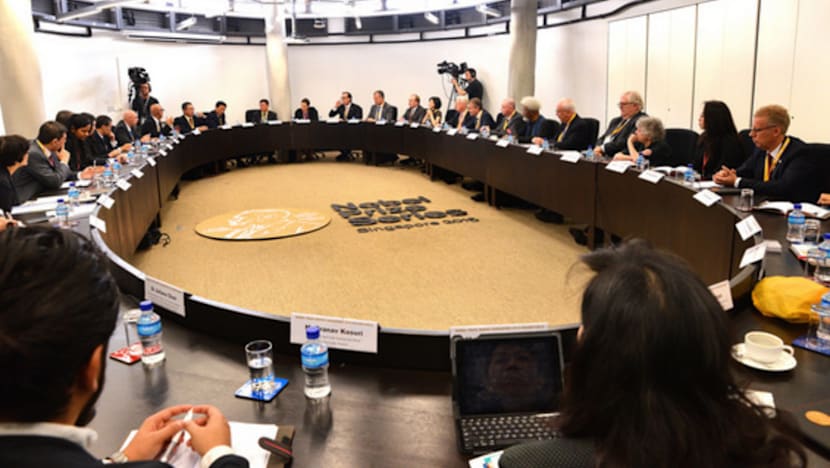
More than 30 of the world’s leading minds, including five Nobel Laureates, scientists, policymakers and thought leaders discussed the future of learning at NTU during the Executive Roundtable of the inaugural Nobel Prize Series Singapore 2015. Photo: NTU


SINGAPORE — When discussing about economic inequality, one should should not just look at differences in income levels but take into account elements of “actual wealth”, such as investment, assets, and family inheritance, said Nobel laureate Sir James Mirrlees today (Oct 6).
In a public lecture delivered at the Singapore Management University, Sir James noted that according to an Oxfam International study, the world’s wealth is concentrated among the top percentile of the rich.
In a study released earlier this year by Oxfam, the anti-poverty charity said that based on current trends, it expects the wealthiest 1 per cent to own more than 50 per cent of the world’s wealth by 2016.
However, Sir James, in his lecture entitled “The Causes of Economic Inequality”, argued that for a better gauge of economic inequality, one should not only measure income equality, but also take into account other factors such as wealth inequality.





A person’s wealth would include things such as his past income, assets, whether he is in debt, or perhaps may have received a sudden windfall, such as family inheritance, said Sir James, who won the Nobel Prize in Economic Sciences in 1996 for devising a theory of optimal income taxation.
Noting that economic inequality has a far-reaching impact beyond the realm of economics, Sir James said the degree of inequality would affect how political power and how society’s welfare were distributed, hence prompting governments to intervene.
“...The rich can buy influence, in varying degrees, depending on country or individual … America’s a notorious case... it’s been shown that it’s possible to obtain considerable influence just by being rich,” said Sir James, who is currently a Distinguished Professor-at-Large at the Chinese University of Hong Kong.
He said a redistributive tax -- which he described as a form of “insurance” — could help to narrow economic inequality.
Referring to a Robin-Hood style kind of taxation — where those with high income earnings are taxed highly while those with low income earnings are subsidised — Sir James stressed that redistribution of income does make a “difference.”
He noted that this model seems to have worked in Scandinavian countries, such as Denmark and Sweden, which are among the most heavily taxed countries in the world, yet where some of the most creative and entrepreneurial minds thrive.
“With such high taxes, you’d expect people to leave the countries, but in fact there are not so many emigrants,” he said, although stressing that it may vary from country to country.
When asked if money should be diverted away from financial speculation to actual value- creation, Sir James said society should encourage a culture of philanthropy.
He noted that “American heroes”, such as billionaires Bill Gates and Warren Buffett, have contributed their wealth to various charities and deserving causes.
On the issue of global taxation, Sir James said while it was an attractive approach to consider, it would be difficult to carry it out in practice.
Citing the example of the European Union, he said: “ I don’t think it will happen in our lifetime, but it is an ideal.”
Sir James’ lecture is part of the Nobel Prize Series, a joint venture by Nanyang Technological University, Nobel Media and Nobel Museum. The series brought four other distinguished Nobel laureates to Singapore.