Times change, but teachers’ role in forging a nation remains: Heng
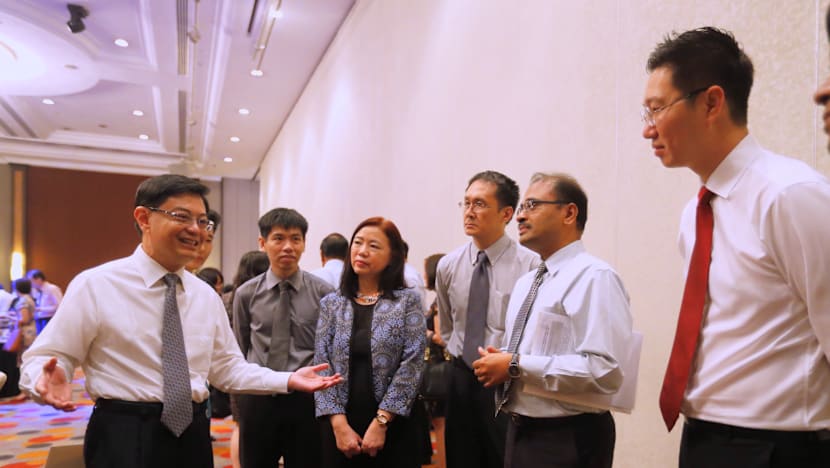
Education Minister Heng Swee Keat mingles with recipients after the Ministry of Education's promotion and appointment ceremony held at Orchard Hotel on 17 April 2015. Photo: Ernest Chua


SINGAPORE — Compared with the resource-strapped pioneer batch of teachers in the 1950s who often had to double-hat or improvise, teachers today draw competitive salaries, work in schools with good facilities and have many development opportunities. Differing circumstances aside, the mission of teachers has remained the same — moulding the future of the nation through fostering a sense of togetherness.
Education Minister Heng Swee Keat made this point today (April 17) at his ministry’s promotion and appointment ceremony for 6,711 educators and school officials, where he exhorted teachers to emulate “the pioneering spirit of resourcefulness, resilience and responsibility (that) allowed them to educate an entire generation with limited resources, and made us what we are today”.
He cited founding Prime Minister Lee Kuan Yew’s message in the 1959 Teachers Rally that they have a critical role — given the divide along language and religion then — of nurturing in students a sense of common destiny and togetherness.
Through decades of efforts, children now go through common experiences in schools that has helped develop a sense of unity as a people, helping Singapore to weather some adversity well, such as the Asian Financial Crisis and SARS, he said. Still, “this sense of nationhood will always be a work in progress”, stressed Mr Heng.





“Each generation faces new forces that can divide us, weaken our sense of togetherness,” he said. “The better educated our students, the more sought after they will be by the world. So there are also forces that will disperse us beyond our shores.”
The demand on teachers to provide that common experience in schools in order to forge the sense of togetherness will grow, Mr Heng added.
That is why the Character and Citizenship Education in schools today to inculcate values and national identity is a top priority, he noted.
Recounting the national week of mourning for the late Mr Lee last month, where he met a student and her parents at the Padang at 4am one morning, Mr Heng was moved by the parents’ thought that getting their child to wear the uniform to pay respects to Mr Lee was the “right thing to do”.
“(But) it is not just about what you wear on the outside. It is about what you carry inside, the experience our students get in school ... it is this sense of identity (that) teachers build,” he said.
Schools and teachers have to collaborate to nurture a child, while teachers need to put in effort to stimulate a student to imagine how to contribute to improve fellow Singaporeans’ lives, he added.
“That is how, whatever is thrown at us, we will find ourselves standing together in the Padang in the morning, anywhere, anytime, taking care of one another, proud to call ourselves, a part of this family, this school, this nation,” said Mr Heng.
When Parliament sat earlier this week, the House also discussed how to provide students a deeper understanding of the late Mr Lee’s contributions to Singapore. Prime Minister Lee Hsien Loong also noted that National Education content will be reviewed.
In response to TODAY queries, the Ministry of Education (MOE) said it will study how to “further strengthen the teaching and learning of the late Mr Lee’s legacy and what the pioneer leaders believed in”. One possibility is by tapping on resources that have surfaced during the week of national mourning, such as videos on Mr Lee’s life and work. “MOE is working on the details and will share them at a later stage,” a spokesperson said.
Here is Mr Heng’s speech at the ceremony in full:
1. This year, we promote 6,711 officers – education officers, allied educators, and executive and administrative staff.
a. It takes a strong team of officers in the professional and administrative tracks to build a strong education system.
b. Congratulations to every one of you.
c. And thanks to family whose support is so important.
Pioneer Educators Built a Nation
2. Two weeks ago, MOE celebrated pioneer and senior educators at Gardens by the Bay. About 12,000 came, including family and friends.
3. An amazing group. Did so much with so little.
a. In the late 1950s, our teachers not only had their salaries reduced but also had working hours lengthened, to cope with the shortages of resources.
i. Interestingly, when I meet a pioneer educator today, they relive these memories not with unhappiness, but with pride.
ii. They should be proud. It wasn’t just about hours or duties – they built a nation.
b. Example: In one school, only the Principal and one teacher. One teacher taught some subjects. Principal taught everything else, plus lock and unlock the school gate.
c. Example: In another school, for track and field, they had a field but not the track. But every year, teachers had to draw the track themselves.
d. The pioneering spirit of resourcefulness, resilience and responsibility allowed them to educate an entire generation with limited resources, and made us what we are today.
e. Achieved so much, but, at the event, remained humble and appreciative.
4. Not just humble and appreciative. Keeping a strong sense of mission.
a. Many are long retired, but they have been keeping track and keeping notes about our education system.
b. Used the occasion to tell me (and maybe SMS and SPS too) what we can do to teach grammar, math, arts, sports, and so on, better. Not just ideas. Volunteered too. Some started publications. Happy to hear from them.
c. One thing that kept coming up, that is very important to pioneer teachers:
i. As individuals – values and character of our children;
ii. As a nation – our sense of togetherness and of who we are as one people.
Our Mission Today: Foster Togetherness
5. What is this Sense of Mission that continues to grip our pioneer educators?
a. Today, schools have good facilities. Teachers draw competitive salaries, many development opportunities. World is different. Pedagogies and curriculum much improved and continually evolving. Nature of learning itself is transformed. Is the teacher’s mission still the same?
b. Our pioneer educators offer us a glimpse of the future: When you are 100 years old, which part of the Teacher lives on the strongest in you?
c. Learning from pioneer educators: What lives on is not that you always correct people’s mistakes. Not that you are always the most well-informed on your subject. Not that you always keep the instinct to nurture. It could be these things. But it is not just these things.
d. In the Singapore context, it is this: you always care, you always feel invested in, you always believe you can do a part in growing our people, building our nation, moulding our future.
e. We can see this sense of mission alive and strong in our pioneers.
f. In the Singapore context, whether it is 1965 or 2015, this mission is always important for our teachers.
6. The week before our celebration with pioneer educators, we had the extraordinary week of mourning, in which Singaporeans showed the deep reserves of care for one another, and staunch love for our home and those who have built it.
a. Singaporeans showed that we know who we are, what we care about – we are one nation, we care about the values and opportunities this nation stands for, and we care about our fellow Singaporeans.
b. What we have grown to be is a result of everything in society, everything that happens around us. Schools have a very significant role.
c. I went to the Padang one night, or morning, at 4 am. I was surprised to see many students. I met one girl who was there with her parents, in her school uniform. I asked if she came from school, but her parents said no. They went together from home in the evening, but the parents said she should go in her school uniform. They said, “We just think it’s the right thing to do.” The girl was happy to take her parents’ advice. In fact, the whole family was in good spirits at 4-plus in the morning. Her school uniform still looked nice and neat, and the girl herself bright-eyed and lively.
d. The whole thing touched me deeply.
e. It is not just about what you wear on the outside. It is about what you carry inside, the experience our students get in school – the challenges but also the triumphs; the questions but also the affirmations; the foundations that reach deep and the connections that spread wide – it is thanks to these that, at 4 am in the morning, when we stand together with our families and our fellow Singaporeans, we are proud to declare ourselves as being of this school, of this nation.
f. It is this sense of identity, together, that teachers build.
7. In 1959, at the Teachers Rally in 1959, our founding Prime Minister Mr Lee Kuan Yew said: “It is no exaggeration to say that the 10,600 teachers in all our schools constitute the most influential group of 10,600 people anywhere in Singapore”.
a. He went on to say, “The future is ours to make. In the youth of today are the leaders and citizens of tomorrow.”
b. Mr Lee explained the critical role of teachers in nurturing our students to have a sense of common destiny, a sense of togetherness, regardless of race, language or religion.
c. He also said on another occasion, “As teachers, you have a special role in the community. You can help to bring up the next generation, more united, more as one in outlook and sentiment.”
8. That was 56 years ago.
a. Context then: children were going to different types of schools, and most of their parents were first generation, divided by language and religion.
b. After decades of efforts by very committed educators, our children now go through common experiences in schools that had helped develop a sense of unity as a people.
c. But whatever progress we have made, we must recognise that we are still at an early stage of our nation building, and a sense of being Singaporean. Year by year, we get better.
9. Almost 30 years later, a European newspaper asked Mr Lee about our process of nation-building. The reporter said it was “astounding.”
a. Mr Lee said: “Our peoples have come here from older civilisations, from Indonesia, from India, from China. The only common feature is that we share this small and inadequate piece of land on which we make our common living. But this is too narrow a base of national unity to face adversity. We must feel that we are one people, regardless of our many races, many languages, many different histories, so that we can face a difficult period together. Can we hold together, suffer together? Are we willing to sacrifice for each other? So we have to try to increase the sense of belonging, of togetherness, of being a nation.”
10. In this 1987 interview, Mr Lee spoke of the sense of nationhood, of being together in adversity, not just for one or two years, but over five years, like the Great Depression in the 1930s. We have weathered some adversity well – like the Asian Financial Crisis, 2003 SARS. Mr Lee’s passing also brought Singaporeans together.
a. But this sense of nationhood will always be a work in progress.
b. Each generation faces new forces that can divide us, weaken our sense of togetherness.
c. The better educated our students, the more sought after they will be by the world. So there are also forces that will disperse us beyond our shores.
11. As educators, we must develop:
a. A sense of caring – knowing the people, the values and goals that are important to us, that are worth protecting, worth standing up for.
b. A sense of unity – knowing the special things, be they history or culture or even the little quirks of being Singaporean, that define us as one united people regardless of race, language, religion.
c. A sense of citizenship – knowing the common destiny we are headed for, we are building together.
d. A sense of resilience and ruggedness, like we see in our pioneers – knowing that things will go wrong and setbacks will come, and staying resolved that while we cannot predict them, we can adapt, bounce back, overcome, when things go wrong.
e. A sense of caring, a sense of unity, a sense of citizenship, a sense of resilience. If we can nurture these in our young, in one another, this is how we fulfil our mission to foster a sense of togetherness.
f. This is how, whatever is thrown at us, we will find ourselves standing together in the Padang at 4 am in the morning, taking care of one another, proud to call ourselves a part of this family, this school, this nation.
12. Our schools must provide that common experience to forge this sense of togetherness. The demands on you, our educators, to do this well will grow. The task grows more complex by the day.
a. Put Character and Citizenship Education (CCE) as a top priority.
i. Many of you say it is the most difficult to teach. It is also, in my opinion, the most important.
ii. These qualities cannot be learnt just in theory, in classroom context. Needs to be deeply internalised. Needs to be acted upon, through Values in Action (VIA).
iii. Every teacher is a CCE teacher. In fact, every member of the school staff, school leaders, teachers, allied educators, our executive administrative staff – we all have this role in CCE, in all our interactions with the students. Should be infused across our curriculum, in different ways, into school life.
iv. Take a forward orientation – challenge/stimulate your students to achieve ideals and maintain values, imagine a better future together, and working together to bring this about.
v. Learning/practice of CCE should not stop at school gate. We need to engage parents and work together with them.
13. Our teachers will need to have the knowledge, imagination and lively interest in Singapore and the world around us, to read up widely, to collaborate, and to stimulate student to imagine how every aspect of our life can be better, how we can forge a sense of common destiny and togetherness.
a. You are here today because you have done well. I hope you will rise to the challenge to build this sense of togetherness in young Singaporeans.
b. Your students will go on to do amazing, inspiring things themselves. They will stand with their fellow Singaporeans in times of hardship. They will come up with solutions that we can’t even imagine yet. Who they will be, all they will do, it is shaped by your teaching.
c. You yourself will be the next generation of pioneers. I hope that many of you will make it to SG100. At SG100, when you go and tell the future Education Minister how MOE can do
things better, let me make one guess – you will find that of all the many things you have done as an educator, you will be proudest of the values you passed on to your students, of your contribution to the sense of togetherness that holds our little island nation together.
14. In 1959, Mr Lee said to the teachers, you are the most influential group of people anywhere in Singapore. All of you here today are part of a total team of educators, allied educators and executive administrative staff with a strong sense of mission. And working together, you are the most influential people anywhere in Singapore.
15. Congratulations again to all of you. I wish you joy, support, and meaning in every day of your work, as we continue to mould the future of Singapore.
16. Thank you.