Trebling of cycling network could be sped up by ‘a couple of years’ to offset e-scooter footpath ban: Lam Pin Min
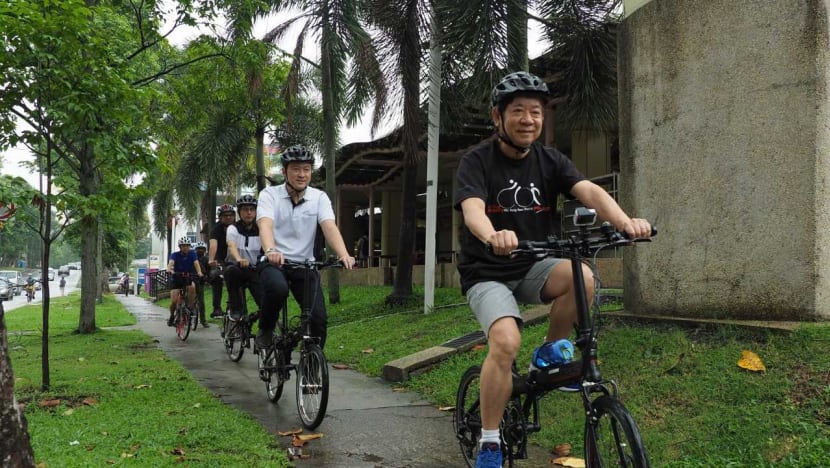
Transport Minister Khaw Boon Wan (right). Senior Minister of State for Transport Lam Pin Min and other officials cycling in Ang Mo Kio on Tuesday (Dec 17).


SINGAPORE — A three-fold expansion of Singapore’s cycling path network could be brought forward by “a couple of years” to give e-scooter riders more places to ride after they were banned from footpaths, Senior Minister of State for Transport Lam Pin Min said on Tuesday (Dec 17).
“The reason we are doing this is because with the announcement of the ban of e-scooters on footpaths, the connectivity of active mobility users has been affected,” Dr Lam said.
The ban, which took effect on Nov 5, means that e-scooter riders can ride only on park connector networks (PCNs) and cycling paths. PCNs are shared running, walking and cycling paths. There are currently 440km of paths available to cyclists.
Dr Lam announced earlier that the LTA will expand Singapore’s cycling path network to 750km by 2025 and 1,300km by 2030.





“We are currently looking at the timeline, hopefully we'll be able to bring it forward by a couple of years,” he said on Tuesday, at a media doorstop interview at a cycling event in Ang Mo Kio.
Dr Lam said the Land Transport Authority (LTA), together with the Ministry of Transport, are working with grassroots advisers in various town councils to achieve this goal, and will consider the possibility of reclaiming roads to create space for cycling paths.
He cycled along a 6km route in Ang Mo Kio with Transport Minister Khaw Boon Wan, Senior Minister of State for Transport Janil Puthucheary and Active Mobility Advisory Panel chairman Faishal Ibrahim.
Dr Lam added that Ang Mo Kio would be a “role model town” in terms of promoting active mobility.
The LTA is currently building another 16km of cycling paths in Ang Mo Kio town by 2022. Upon its completion, the cycling network at Ang Mo Kio will be the longest in any residential town, at 20km, said LTA in a release on Tuesday.
Dr Lam hopes that similar “active mobility infrastructure” can be built in other towns, but recognises that there are challenges.
“As much as possible we will try to create as many cycling paths… I understand that in various towns there may be physical constraints,” said Dr Lam.
“But LTA has come together with the various agencies, like the National Parks Board and the Urban Redevelopment Authority, to see how we can optimise the space available.”
This includes the possibility of reclaiming roads to create more space for active mobility infrastructure such as cycling paths.
Some features that cyclists and e-scooter riders can look forward to in Ang Mo Kio by 2022 include:
Cycling paths from reclaimed road and drain space
Bicycle wheeling ramps, to help cyclists push their devices up stairs that lead to cycling paths without carrying them
More zebra crossings and bicycle crossing facilities
Redesigned bus stops with spaces behind to accommodate cycling paths
More bicycle-parking facilities
LTA announced separately on Tuesday in a Facebook post that it will be implementing markings on footpaths to warn e-scooter riders against riding on them.
These markings aim to “educate path users and help them distinguish between a footpath and a cycling path”, and have been rolled out in estates such as Jurong and Sembawang.
LTA also reminded the public that the ban will be strictly enforced from Jan 1. If convicted, errant riders can be fined up to S$2,000, jailed for up to three months or both.