UniSIM law school to enrol first student batch in 2017
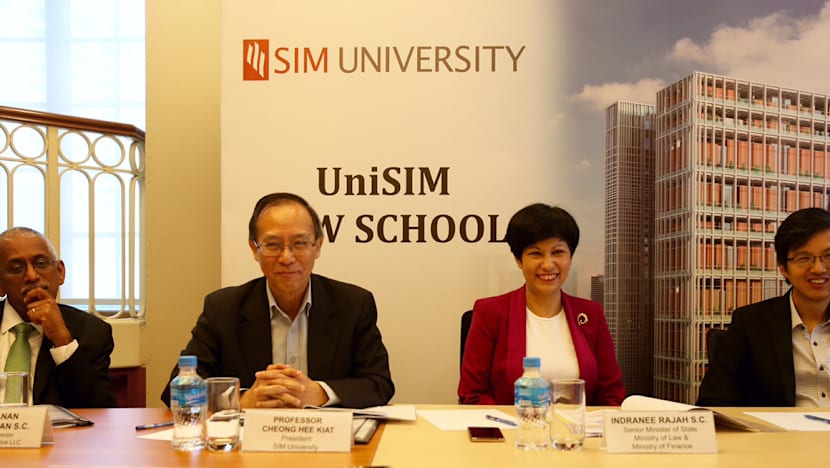
From left: Managing Director of Straits Law Practice LLC Narayanan Sreenivasan, President of SIM University Cheong Hee Kiat, Senior Minister of State (Law and Finance) Indranee Rajah, Permanent Secretary at the Law Ministry Ng How Yue at a press conference to announce the establishment of UniSIM Law School on Feb 16, 2016. Photo: Don Wong


SINGAPORE — To ensure its graduates can “hit the ground running” in the specialised field of criminal and family law, the Republic’s third law school will have to undergo a compulsory six-month practicum at the end of their course.
Unique to the UniSIM Law School — which will receive its first co-hort in January next year — this graded internship will see students working directly with clients and drafting legal arguments under the supervision of senior lawyers, among other things, said the steering committee overseeing the establishment of the law school today (Feb 16). Students will still need to complete a training contract.
The pioneer co-hort will comprise 50 to 60 students, and at least 80 per cent of the places at UniSim Law School will be set aside for mature students such as those with social work or paralegal experience. UniSIM Law School will progressively increase its annual intake to 75 students at steady state.
Throughout their course — which will be in modular format and offer evening class options to cater to those working — there will also be mandatory classes on professional skills such as in mediation. The curriculum will be cross-disciplinary, with classes on social sciences and forensic science for instance, to provide a strong foundation for students when they focus on family and criminal law in the second year.





Non-degree holders can take four to six years to earn a bachelor of laws, while degree holders can attain a Juris Doctor in three to six years.
The establishment of the third law school comes after recommendations from a committee looking into the supply of lawyers, which noted a shortage of lawyers practising community law. A steering committee, headed by Senior Minister of State for Finance and Law Indranee Rajah, was then set up in November 2013 to guide the planning of the new law school.
Today, Ms Indranee noted the need for more family and criminal lawyers due to a steady pool retiring every year while young lawyers typically do not hold out in these areas of practice, creating a “hollowing out effect”.
By setting aside the majority of places for mature students, the university is trying to “identify upfront these individuals who are passionate in this area … So, it is not a question of ‘is this what you are going to do?’,” said Ms Indranee.
Senior Counsel Narayanan Sreenivasan, also a committee member, added: “In family and criminal law, being older actually helps. (For instance), you are dealing with an upset couple in a divorce and you got the issue of custody…you can tell them what their kid is going through and it helps if you are a parent.”
The admission process will begin next month and Ms Indranee said the school will look beyond applicants’ “historical grades”. This means that besides basic qualifications such as holding A-levels or a polytechnic diploma, applicants will have to obtain satisfactory scores on a law aptitude test — called Law National Aptitude Test — or on basic family and criminal law courses.
After passing this first stage, students will be admitted based on interviews or their involvement in community work, among other criteria.
Family and criminal lawyers interviewed by TODAY were uncertain if admitting mature students would mean they will stay the course, due to the demanding nature of these practice areas, and the relatively lower remuneration.
Family lawyer Rajan Chettiar of Rajan Chettiar law firm noted that the practice of law could also be different from the work these individuals have been used to doing. But he agreed on the need for a “practice-oriented” curriculum beyond legal theory. “For family and criminal law, you need the soft skills in dealing with a whole range of people”, said Mr Chettiar.
The committee is exploring the possibility of co-locating the new law school with the new State Courts which is under construction, or with the Family Justice Courts. Senior Counsel Leslie Chew, who was previously a senior district judge for seven years, will be heading the UniSIM Law School and fees are currently being worked out.