Work during train operating hours unavoidable, must be safer: Analysts, MPs
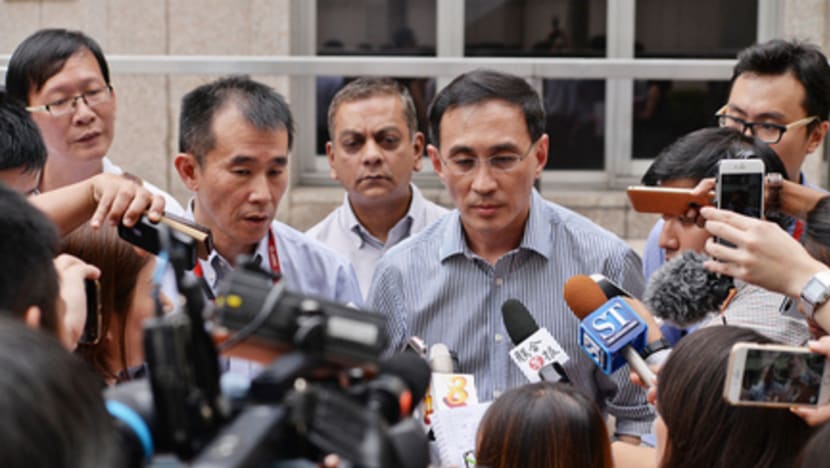
SMRT’s group CEO Desmond Kuek (centre right), who spoke to the press yesterday at SMRT’s headquarters with managing director of trains Lee Ling Wee (centre left), said permission had to be granted before staff can access the tracks. Photo: Robin Choo


SINGAPORE — In the wake of the deaths of two SMRT employees yesterday, transport experts and Members of Parliament (MPs) have questioned whether there are safer ways of carrying out maintenance work on MRT tracks when trains are running, even though they acknowledged that such work during operating hours was unavoidable.
The two men who were killed yesterday — Mr Nasrulhudin Najumudin, 26, and Mr Muhammad Asyraf Ahmad Buhari, 24 — were part of a team that had been walking along a walkway on the side of the tracks to investigate a reported alarm.
SIM University (UniSIM) senior lecturer Walter Theseira noted that it would be “unrealistic” to expect absolutely no maintenance work to be done during operation hours.
“It seems that, certainly, work to check on a potential fault would be something that should be done as soon as possible. Especially if, unchecked, the fault could cause a problem for train operations,” said Dr Theseira. “So I think in our evaluation of this terrible tragedy we have to accept that risky work must take place and the main thing is to ensure that risks are minimised.”





Mountbatten MP Lim Biow Chuan, who sits on the Government Parliamentary Committee (GPC) for Transport, questioned whether the walkway to access the train tracks was safe enough. “If you have someone on the track, and there’s a moving train nearby, it doesn’t sound very safe to me. There must be a minimum clearance area for safety measures to be properly adhered to,” said Mr Lim.
UniSIM adjunct associate professor Park Byung-joon asked about the kind of safety training provided for staff before they are allowed to access the train tracks.
“I hope that this investigation will find out (about) the training provided to the trainees — the safety procedure when they walk on the track. And they must have some kind of safety procedure when a train is coming,” said Dr Park. He added that it might be useful to have an additional pair of eyes to check for oncoming trains as surveillance cameras may not have full coverage of the track.
Addressing the media yesterday, SMRT Corporation group chief executive officer Desmond Kuek said the two men were part of a team of 15 investigating the alarm.
It was “standard” for staff to investigate every fault, regardless of whether it was during operating or engineering hours. “When we detect a fault and we need to troubleshoot it, the first course of action is to go down on the site to determine what is the cause of that signal or fault. And the only way to do so … while service is on, is to walk on the side with supervision and control from the ops control centre and with all the safety and permissions granted,” he said.
Mr Lee Ling Wee, managing director of SMRT Trains, said that as part of the safety protocol, employees must get permission from the (operations) control centre to go down onto the tracks. When the team reaches the site of the investigation, they have to ask for permission again to cut off power to the section. “And in this instance, (the first permission) was given … But unfortunately the accident happened before they reached the site where they were supposed to do the investigation,” said Mr Lee.
As for allowing new staff to access the tracks, Mr Lee said “it is all right” for them to do after they have been properly trained and briefed on safety.
Asked about the clearance space between the walkway and the train track, Mr Kuek said it was “safe passage”. In a graphic sent to the media, SMRT indicated that the pathway was 0.5m wide, separated from the track by a third rail.
Mr Kuek also noted that the two deceased were the second and third in line, with their supervisor leading the group. “So exactly how it is they were hit by the oncoming train when there was a clear line of sight and when there was a supervisor ahead of them, is the subject of investigation,” he said.
While SMRT maintained that the two men were behind their supervisor, TODAY understands that the victims were on the other side of the track when they were hit by the train.