Workplace deaths increase — falls still the leading cause
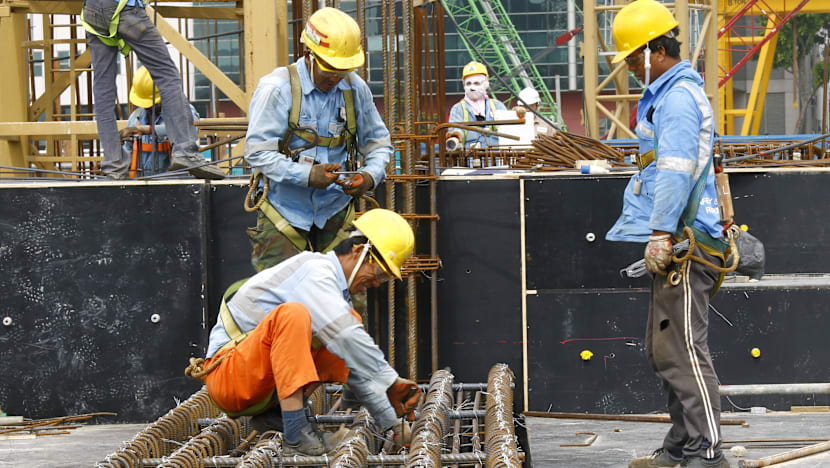
Construction workers working at a construction site, 15 Jan, 2014. Photo: Ernest Chua/TODAY


SINGAPORE — Six more lives were lost at workplaces last year than in the year before, with the construction sector continuing to be the leading site of such deaths.
There were a total of 66 workplace deaths in 2015, even as the overall number of cases involving major and minor injuries fell from 13,535 in 2014 to 12,285 last year.
The latest Workplace Safety and Health Report released on Thursday (March 10) showed that the construction industry contributed to 41 per cent of workplace deaths (27 cases) last year, followed by the transport and storage sector, which made up 23 per cent of the cases (15 cases).
(Click to enlarge)





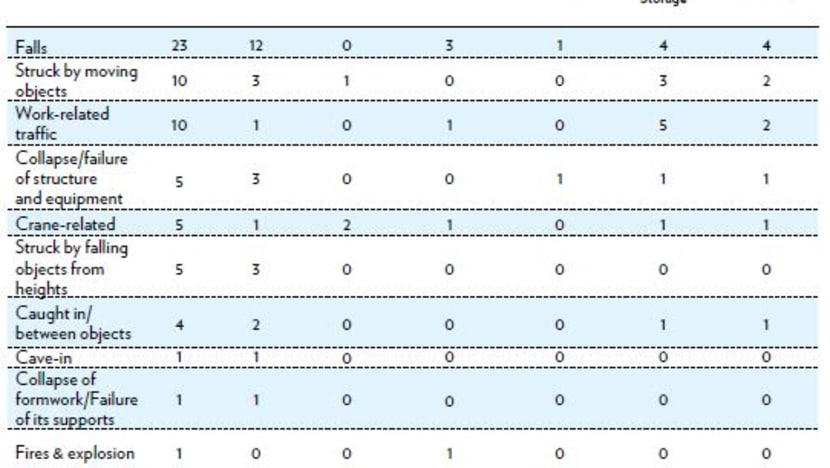
Falls continued to be the top contributor of workplace deaths — with 23 fall-related fatalities last year — and they make up 35 per cent of overall workplace fatalities.
Commenting on the latest figures at a forum on Friday, Minister of State for Manpower Sam Tan revealed that close to 700 Workplace Safety and Health violations were uncovered across 500 worksites recently.
The inspections were done by the Manpower Ministry after a spate of accidents this January alone where nine workers died, and seven workplaces were issued with stop-work orders.
Some of the conditions officers found were appalling, Mr Tan said. For example, openings and open sides of structures were left unguarded, with no safe means of access to places of work, and unsafe scaffolding.
“We need to redouble efforts to prevent accidents because every worker has the right to go home safe and healthy every day... We owe that to our workers and ourselves,” Mr Tan said.
The latest statistics also showed that other top causes of workplace deaths were victims being struck by moving objects (10 cases), and work-related traffic accidents
(10 cases).
There were five crane-related deaths last year, while the number of dangerous occurrences involving crane operations also nearly doubled from 12 cases in 2014 to 22 in 2015.
To address these concerns, the ministry and the Workplace Safety and Health Council will be launching new initiatives to help employers improve safety in areas such as falls prevention, traffic safety management and crane safety.
A new work-at-heights safety “mobile clinic” will be conducted at small- and medium-sized workplaces by the second half of this year, where experts will review and identify such hazards with the workers and educate them on ways to cut down their risks.
There will also be a new on-site pilot programme by the second half of this year called TrafficSAFE, involving up to 200 companies, to help them assess and implement traffic safety management.
The ministry will step up enforcement efforts; it now conducts up to 500 inspections a month.
When contacted by TODAY, companies stressed that more could be done to inculcate a culture of self-ownership and responsibility towards workplace safety, though they acknowledged that Singapore has already made strides in its emphasis on safety.
Mr Yeo Kim Hock, divisional safety manager of Gammon Construction Limited, said: “The rise in the number of fatalities is not favourable, as one (death) is one too many.”
He urged those at the managerial level to continue to “support and motivate” frontline staff members and workers to be more safety-conscious.
Mr Daniel Woo, corporate safety manager of Erect Group, a building access systems provider, pointed out that it was important to retain older, experienced workers who would be “already inculcated with Singapore’s strong safety culture”, instead of continually hiring new workers.
An observation was that safety improvements seemed to have “plateaued” over the last few years and it is getting more challenging to reduce the fatality rates, Mr Mohd Ismadi noted.
The director of policy, information and corporate services at the Manpower Ministry’s occupational safety and health division said: “A key factor is for companies and industry players to take greater ownership of workplace safety and health outcomes, and to internalise safety within their business, making it a core value ingrained in their employees.”