World leaders pay tribute to Nathan
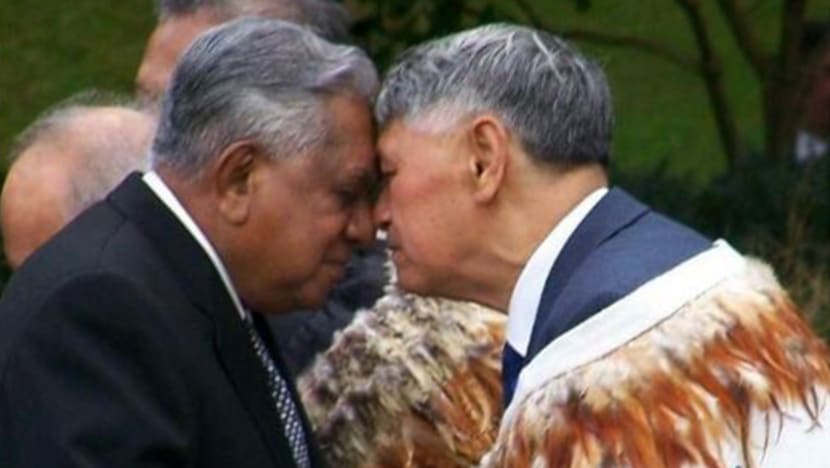
Mr Jonathan Austin, New Zealand High Commissioner to Singapore, tweeted this photo of Mr S R Nathan taking part in a traditional Maori greeting during his 2008 state visit to New Zealand. Photo: Jonathan Austin's Twitter account
SINGAPORE — There was an outpouring of condolences from world leaders yesterday following the death of Mr S R Nathan, a testament to his efforts in expanding Singapore’s diplomatic space and leaving his mark on the international community.
“My deepest condolences to the family of former Singapore President S R Nathan and the people of Singapore,” said Malaysian Prime Minister Najib Razak on Twitter.
Mr Nathan had served as Singapore’s High Commissioner to Malaysia from 1988 to 1990. During his tenure, he worked towards the signing of a new agreement in 1990, to supplement the 1962 Water Agreement. This new agreement led to the building of the Linggiu Reservoir, which allows the PUB to draw water from the Johor River, an important water source for Singaporeans.
Indian Prime Minister Narendra Modi, through the Prime Minister’s Office’s Twitter account, said Mr Nathan was “widely admired” and that he was “saddened” by the former Singapore President’s death.





“We in India join the people of Singapore in deeply mourning the passing away of former President Nathan. Condolences to his family.”
Mr Nathan had visited India in 2003.
In Washington, where Mr Nathan had served as the Republic’s ambassador between 1990 and 1996, State Department spokesman Mark Toner spoke of him during a press briefing.
“President Nathan was a lifelong civil servant whose career spanned all five decades of US-Singapore relationship, including six years as Singapore’s ambassador to the United States, and 12 as its President. We extend our deepest condolences to President Nathan’s family and the people of Singapore,” Mr Toner said.
Former Maldivian president Maumoon Abdul Gayoom wrote on Twitter that he was “deeply saddened by passing of Ex-President S R Nathan of Singapore. Was a great friend of Maldives”.
Mr Nathan and Mr Gayoom had jointly opened a school in the Maldives in 2007. The school was built by the Singapore Government and the Singapore Red Cross Society as part of Singapore’s reconstruction assistance package for the Maldives following the December 2004 tsunami.
Mr Nathan was also active in Singapore’s engagement of the Middle East.
“RIP President S R Nathan, former President of Singapore. Had the honour to accompany him in Bahrain and met him at the Istana,” wrote Bahrain’s Foreign Minister Khalid Ahmad Khalifa on Twitter.
The current British High Commissioner to Singapore, Mr Scott Wightman, also expressed his condolences on Twitter. “Former President S R Nathan served Singapore and its people selflessly,” he wrote.
The British High Commission in Singapore flew the Union Jack at half-mast as a mark of respect.
Singapore’s Ministry of Foreign Affairs (MFA) posted a tribute to Mr Nathan — who served as the Ministry’s Permanent Secretary from 1979 to 1982 — on its website.
The tribute said: “A diplomat par excellence, Mr Nathan was much loved, admired and respected for his warmth and compassion. In MFA, he was legendary for his ability to recall the names of everyone who had worked with him. He always had a kind word for his colleagues, no matter how senior or junior.
“Mr Nathan has seen Singapore through many seminal moments. From social worker, unionist, bureaucrat to being elected to the highest office of the land, he is a defining part of the Singapore Story. We mourn the loss of one of Singapore’s most distinguished sons.”
In a Facebook posting, Foreign Minister Vivian Balakrishnan described Mr Nathan’s life as “a paragon of devotion to the national cause and care for the most vulnerable members of our community”, noting that he had started the President’s Challenge to mobilise all Singaporeans to express their care in practical ways, large and small.
“We will never forget his bravery, devotion, gumption, grit and energy in standing up for Singapore and Singaporeans. We will always owe him and his pioneer generation a great debt that we must pay forward for future generations,” Dr Balakrishnan added.