WP highlights Govt ‘policy changes’ that correspond with its 2011 manifesto
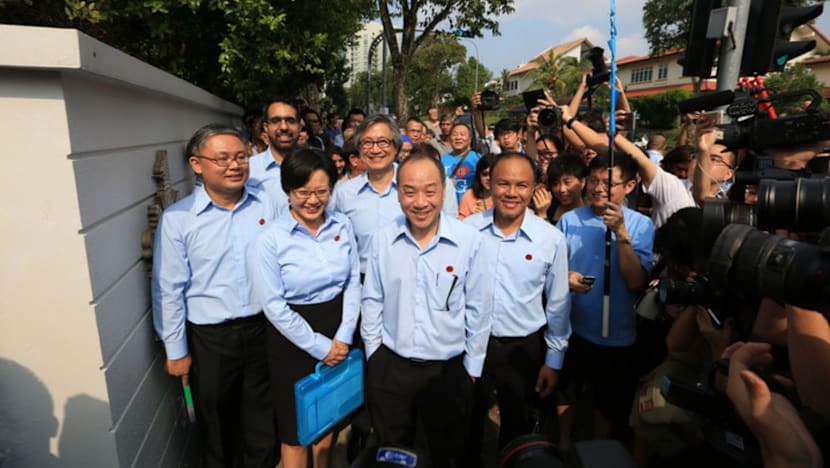
The Workers' Party team at Raffles Institution nomination centre. Photo: Koh Mui Fong


SINGAPORE — The Workers’ Party (WP) has highlighted seven “policy changes” made after the last General Election that it says correspond with its Towards a First World Parliament manifesto proposals in 2011.
And after listing these on its website under the title The Workers’ Party in Parliament, 2011-2015, the party turned to its new manifesto slogan Empower Your Future, with the message: “All credit goes to Singaporeans for the policy changes. Your vote started it all.”
The examples include its proposal of paternity leave of at least six days, with the Government funding half, which the WP said corresponded with the one-week paid paternity leave announced in 2013. Recently, the Government added another week of leave it will pay for, first on a voluntary basis for employers, with the Civil Service taking the lead.
The party also cited the announcement last year that the state was taking over all bus infrastructure and contracting out services to bus companies.





Here, the WP said it had proposed that the Government build public transport infrastructure and pay for the initial operational equipment.
The other changes made by the Government that the WP cited were: The Fair Consideration Framework, MediShield Life, the time lag before new permanent residents can buy a resale flat, all-day concession for senior citizens on public transport and the de-linking of prices between new flats and the resale market.
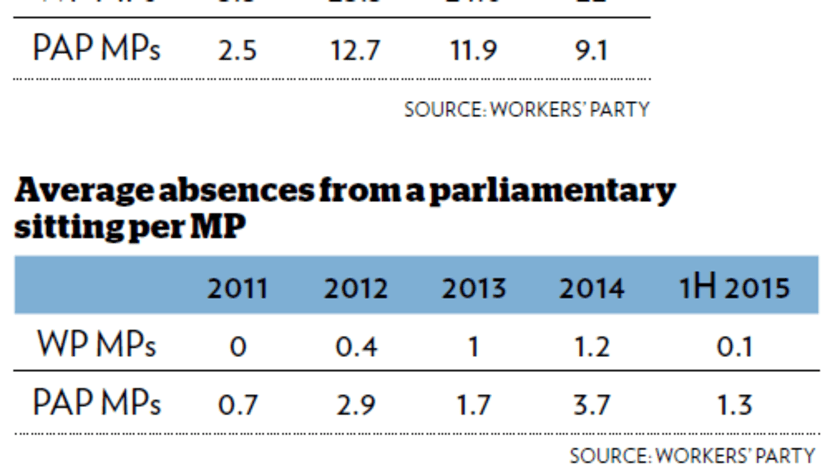
The WP also said its Members of Parliament (MPs) “sought to attend parliamentary sittings faithfully”, and trotted out tables of attendances and the number of questions asked vis-a-vis the People’s Action Party MPs.
For instance, the WP noted that none of its MPs were absent more than seven times, while 34 of the 79 ruling party MPs were absent more than 10 times from 2011 to this year.
Similarly, the WP highlighted that it had filed a higher average number of parliamentary questions, including for the debates on ministry budgets.
“We considered all our questions very seriously,” wrote the WP, adding that each question had an aim, such as seeking “policy changes to better serve the people”.
For the debate on Bills, the WP said its influence on the lawmaking process was “limited” by having only nine MPs in the House, but that they still spoke more than the PAP MPs.
In this area, the WP mentioned a specific debate on the Casino Control (Amendment) Bill in 2012, in which three of its MPs took part.
The WP also listed proposals to transform the childcare sector and ease healthcare costs, and the debates on ministerial salaries and population as its parliamentary highlights.