Young S’poreans ‘must be critical in choosing ideas’
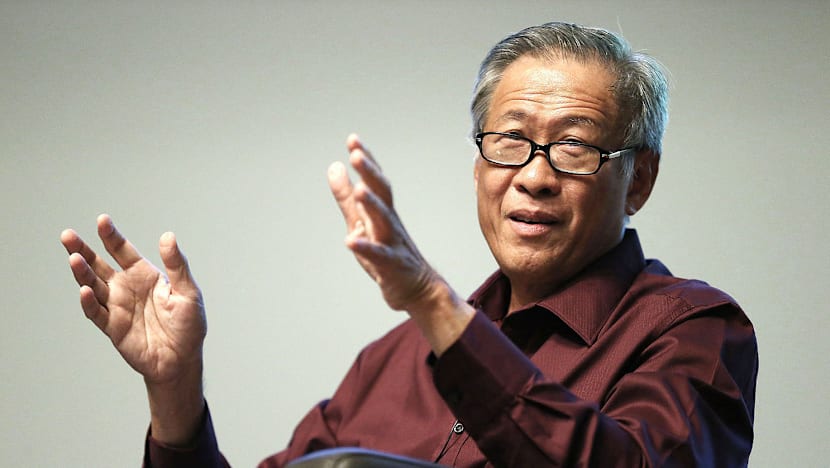
Minister for Defence Dr Ng Eng Hen speaks on SAF 50 and Beyond at NUS University Town on 16 Feb 2015. Photo: Wee Teck Hian/TODAY


SINGAPORE — As young Singaporeans open themselves up to new ideas, they should shun “conventional norms” that are not suitable for society and could actually hurt it, said Defence Minister Ng Eng Hen yesterday.
Speaking to an audience of mainly tertiary students at a dialogue at the National University of Singapore (NUS) yesterday, he urged them to be critical and original.
“I would like you to critically look at some of the ideas that others have for us, because societies are never static. I don’t believe one country has a monopoly of what works,” Dr Ng said.
In examining such ideas, Singapore’s pioneers had created a model which worked for the Republic “in their context, in their time”.





The onus is on the current generation to “assemble the best elements from other societies” to see how they can best serve the citizens, he added.
“If we keep to this idea by our pioneers, if you leave a better Singapore than the one inherited, then I think each generation can look forward to the next, expecting a better Singapore,” Dr Ng told his audience.
The dialogue, organised by government feedback unit REACH and NUS law students, was attended by about 150 alumni members and students from tertiary institutions and junior colleges.
Replying to a question on whether Singapore society is ready for women to undergo National Service (NS), Dr Ng said while the Singapore Armed Forces Act allows for the drafting of women, much care has to be taken in drafting people for “effect”, instead of “equity”.
“NS imposes a burden on anyone you bring in ... When you bring (a person) in, all the problems that come up must justify why you’re brought in, because you can have training injuries,” he said.
A member in the audience pointed out that having women serve NS could create strength in numbers. But Dr Ng said Singapore has to compute in terms of technology and not numbers.
“Ten years ago … we went (up) the technology ladder ... It made a big difference because we now have superior technology that is not only not so dependent on numbers, it allows us to deploy men ... with a wider range of physical ability to operate a superior force, and that is a sweet spot.”
On what can be done to reverse the growing trend of social inequality in Singapore, Dr Ng made three suggestions: Investing resources to allow people to catch up, creating opportunities for all to flourish and having a greater “can-do” spirit.
On the issue of under-representation of Malays in the Navy, he stressed that progress has been made and that Malays are now deployed in every field.
“The organising principle is this — that you should not discriminate against anyone, whether it’s race, gender, other characteristics; that you promote based on ability. For a small population like Singapore, that would be a very important organising principle because you want to get the maximum out of everybody in the SAF,” he said.
VALERIE KOH