

A TECHNOLOGICAL SHOT-IN-THE-ARM FOR HEALTHCARE

PHOTOS: Shutterstock, IMDA
Mr Kenny See and Mr Wu Chia Sheng are IT (information technology) professionals who found their calling in nursing informatics and healthcare, which Mr See describes as being “unlike any other IT job”.
“Nursing informatics is a challenging and meaningful career that marries clinical practices with healthcare IT to improve efficiency for healthcare professionals, and indirectly helps to achieve a better outcome for patients by providing the optimal care needed,” said Mr See.
Their work in the healthcare sector is critical to Singapore’s future, because of Singapore’s ageing population. According to government statistics, the median age of the resident population here rose from 34 in 2000 to 40.5 last year.
The resident old-age support ratio – the number of residents aged 20-64 per resident aged 65 years and above – has also decreased from 9 in 2000 to 5.1 last year.





What the numbers mean is that Singapore’s ageing population will place a greater demand on our healthcare system. The increased use of IT can help alleviate this demand by, for instance, using healthcare analytics to optimise patient services and reduce the waiting time at hospitals.
A MID-CAREER SWITCH
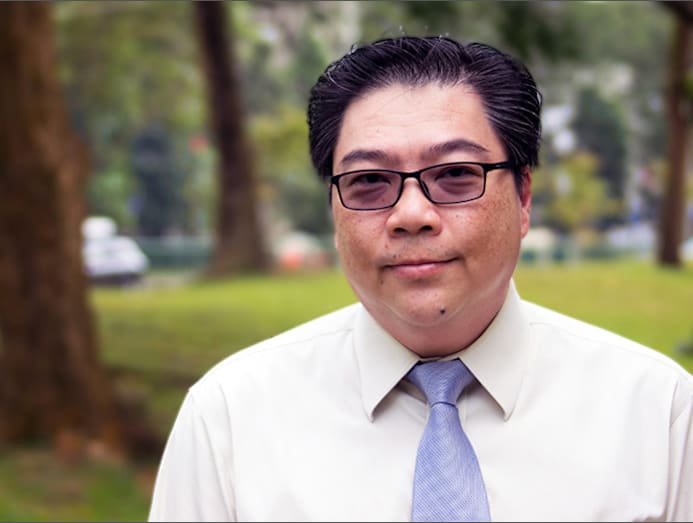
Addressing these challenges is one reason Mr See was attracted to the healthcare sector.
The 47-year-old worked in a local IT start-up for 11 years, climbing the ranks from network engineer to chief technical officer.
When the company ceased operations in 2005, he enrolled in a conversion programme and spent the next two years in an Accelerated Diploma Program in Nursing before becoming a staff nurse in the Intensive Care Unit at the National University Hospital (NUH).
“With my IT background, I felt that this career path allowed me to contribute my knowledge to transform our healthcare delivery to achieve optimal patient care,” he said.
Mr See, who has a Bachelor of Science with Honours in Information Technology from the University of Central England, next took up a Bachelor of Science in Nursing from Curtin University in 2009, graduating in 2011.
When NUH started to adopt IT solutions in healthcare, it was natural for Mr See to become involved in new initiatives like converting paper-based medical records, medication orders and investigation tests to electronic versions.
IMPLEMENTING BETTER SYSTEMS
Today, Mr See is a nursing informatics manager at the Farrer Park Company, where he collaborates with healthcare professionals and the IT project team to implement integrated electronic medical records (EMR) at Farrer Park Hospital.
Mr See’s duties include improving patient safety, bridging the gap between clinical/non-clinical processes and information technologies as well as supporting nurses and doctors in using the hospital’s Meditech EMR system.
The launch of the Meditech system was an exciting period for him and his colleagues. Fortunately, the launch went smoothly and the team only had to resolve minor issues, he said.
“Educating and supporting our business users is the part that I enjoy the most. Most of the time, system limitations and unfamiliarity are the main causes of the mismatch of user expectations,” he said.
“There is no perfect EMR system and all the workflow and processes may not be totally integrated with IT. Our job is to manage user expectations and find the best alternative for their requirements.”
Still, Mr See never forgets that nursing informatics, ultimately, is all about the patients.
“The most rewarding aspect is to see the patients under our care benefiting and getting well, because of the effective patient care made possible by the integration of IT into the health profession.”
FINDING MEANING IN HIS CAREER

The integration of IT into healthcare is a theme that software engineer Mr Wu is familiar with. The 27-year-old works at Integrated Health Information Systems (IHiS), Singapore’s healthtech agency.
He specialises in the Android application development of HealthHub, a national one-stop health portal that empowers Singaporeans to actively manage their health.
Mr Wu, who graduated with a Bachelor in Computer Engineering from the National University of Singapore in 2016, found his way into the sector through a year-long internship at a med-tech start-up company.
“That was when I realised healthcare would be a meaningful sector to work in,” he said.
“Healthcare is a massive sector that is riding on the digital transformation wave. I really like the fact that IHiS is focused on improving healthcare with technology, and how it gives me a chance to be part of national scale projects that deliver value to Singaporeans.”
For instance, IHiS helped develop and roll out HealthHub modules that allow Singaporeans to access their personal and family members’ health data, prescription records and lab test results, do health assessments, as well as obtain health information.
In developing the mobile application for these modules, Mr Wu derives a deep sense of satisfaction that his work enables Singaporeans, including his loved ones, to proactively manage their health.
A TEAM EFFORT
Mr Wu said: “Enterprise-level applications are so complex that they require a team that runs on a systematic process to develop and maintain them. My managers have helped me a lot by explaining how the Healthhub system and development process work at a high level.”
“Knowing that I am part of a team in a company that is dedicated to improving healthcare with technology keeps me motivated to work,” he said.
“One of my most memorable moments was my first HealthHub new major-release deployment night. It was a day filled with excitement and anxiety. The deployment was not easy because many components had to deployed in the correct order.
“We had a mini-celebration at about 3am after the deployment, and the sense of satisfaction came from the fact that new features had been rolled out to the public.”
Though work may get challenging at times, Mr Wu remains undaunted as he views these challenges as a way to work with his team and further hone his skills at software development
A DYNAMIC SECTOR WITH MANY OPPORTUNITIES
Mr See and Mr Wu are just two professionals in an increasingly vibrant sector. To find out more about how IT is being integrated into the healthcare sector and to discover what opportunities await, register for Health Tech Day, which will be held at several venues:
Main venue: SMU Labs (Stamford Road)
Site visits (limited slots): Philips, Tan Tock Seng Hospital, IBM and Singapore General Hospital
Date: March 16, 2018
Time: 9am to 6pm
Hear from industry experts, including those from Philips, Microsoft and IHiS, as they discuss the healthtech landscape and opportunities.
Talk to Singapore Computer Society career mentors to gain industry guidance. Speed-networking sessions with employers are also available.
To find out more, visit here.




