

Ditch the ‘hard Brexit’ fallacy
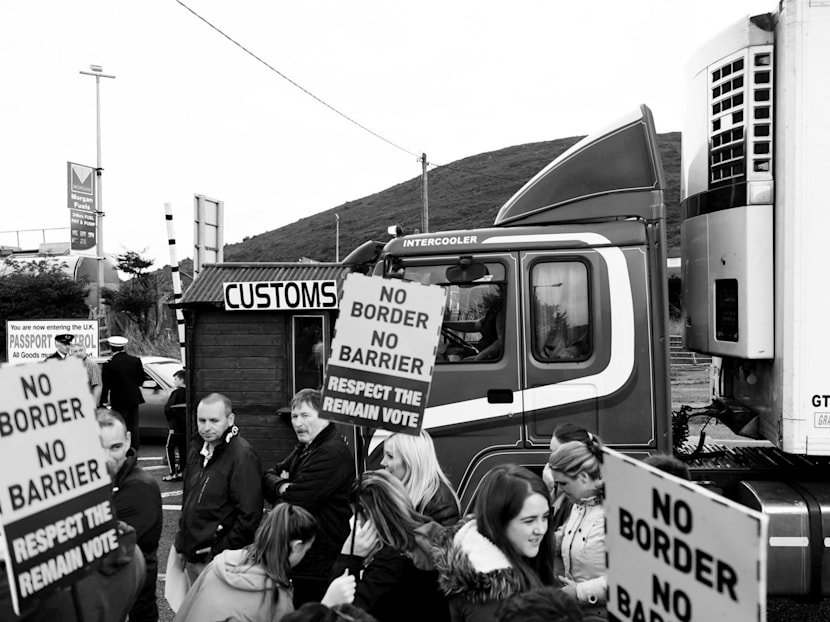
Anti-Brexit campaigners, Borders Against Brexit, set up a mock customs hut during a protest against Britain’s vote to leave the European Union, at Carrickcarnon, Ireland, on Saturday. The EU’s desire to punish Britain for its rebellion is palpable. Photo: REUTERS
Will Brexit be hard or soft? The question preoccupies British politicians and commentators — not to mention global currency markets, if the sharp fall in sterling last week is any guide.
Despite its command of the discussion, however, this hard-or-soft framing is unhelpful. It is best dropped altogether.
The sterling slumped after Prime Minister Theresa May announced on Oct 2 that she would start the European Union’s (EU) Article 50 exit process no later than the end of next March.
She also repeated that she will insist on restoring national control of immigration, even if that means no longer being a member of the EU’s single market.





The reaction was uniform.
The government has chosen a hard Brexit. Let the panic commence.
This hard-or-soft framing conflates a bundle of very different questions.
Will Brexit take the United Kingdom out of the single market? Will Britain face trade barriers? Will Brexit mean strict immigration controls? Will Britain and the EU separate on acrimonious terms, ending close cooperation on issues other than trade? Will the exit be disorderly and disruptive?
Declaring that Brexit will be hard implies (and is usually intended to imply) that the answer to all those questions must be yes — and that hard thus equals disastrous.
Not so. Let us take each in turn.
Will Brexit take the UK out of the single market?
Membership of the single market, according to the EU treaty and settled EU doctrine, requires upholding four supposedly indivisible freedoms — free trade in goods, services and capital, and free movement of people.
The fourth freedom is avowedly political not economic: Its purpose is to dissolve the EU’s internal borders.
The supranational character of the EU project is the very thing Britain objects to, and the very thing the bloc insists on.
So, yes, Brexit means rejecting the fourth freedom, which in turn means no longer being a member of the single market.
Nobody should have needed Ms May’s speech for clarification on this.
trade barriers
Moving on, will Britain face new trade barriers?
This remains to be seen. Membership of the single market guarantees free trade, but non-membership does not in any way rule it out. Ms May’s government says it wants free trade.
EU governments say they will have to see. This second kind of “hard Brexit” — trade restrictions — could happen. But it is not something Ms May just chose, either as a goal or as the unavoidable consequence of resigning Britain’s single-market membership. Rather, it is something the EU might decide to inflict. This kind of hard Brexit would be Europe’s choice, not Britain’s.
Let us pause to ask whether such a response on the EU’s part would be just or sensible. Neither, in fact.
Britain is accused of wanting to “cherry-pick” its future relations with the EU, but the charge, never questioned, makes no sense. (Is the EU saying that the fourth freedom is a cost to be borne by all?)
Freedom of movement is supposed to be a benefit. If Britain rejects it, according to EU theory, Britain loses. (How is that “cherry-picking”?) Equally, the EU has a strong economic interest in free trade with the UK — including in financial services.
Neither fairness nor economic self-interest requires the EU to raise trade barriers against the UK.
Will Brexit mean strict immigration controls for EU citizens?
It need not, and Ms May’s government seems unlikely to want such a system. A liberal work-permit scheme, with preferential (and reciprocal) access for EU citizens would be best.
This might upset some hardline anti-immigrant Brexit supporters, but there is no need for Ms May to let that subset of the pro-Brexit constituency dictate policy.
Indeed, the government should make clear that what is at stake in rejecting the fourth freedom is a constitutional principle rather than any specific immigration policy.
Henceforth, Britain controls its borders. Once that power is repatriated, successive parliaments will face the decision of how hard or soft Britain’s immigration controls ought to be.
Will Britain and the EU separate on acrimonious terms, bringing close cooperation on issues other than trade to an end?
Again, this need not happen. Mutual interest argues for the friendliest possible divorce — and for continued, indeed closer, cooperation on issues such as defence and security.
Will the exit be disorderly and disruptive, or calm and methodical? Calm and methodical would obviously be best, and calm and methodical are obviously what Britain will want.
The early signs are that other EU governments have mixed feelings on the point.
The desire to punish Britain for its rebellion is palpable — and up to a point forgivable, because if Britain makes a success of Brexit, other EU members might be inclined to give it a try.
Yet the EU cannot impose heavy costs on the UK without imposing at least some costs on itself. Europe’s economies are not exactly flourishing these days.
The best way to make the EU more popular is to promote growth and raise living standards. Putting that goal second to punishing the UK might have the opposite effect to the one intended.
Summing up, if you leave the European Union, you leave the European Union: That is neither hard nor soft, it just is.
Stepping aside from Europe’s political project does not dictate whether Brexit will be hard or soft in those other crucial respects.
If Britain’s new prime minister is wise, she will want Britain’s economic relations with the EU to be as close as possible.
If the European Union’s leaders are wise, they will want the same. BLOOMBERG
ABOUT THE AUTHOR:
Clive Crook is a Bloomberg View columnist and a member of the Bloomberg View editorial board. He previously worked at The Economist for over 20 years and was chief Washington commentator for the Financial Times.




