

TPP debacle signals American decline
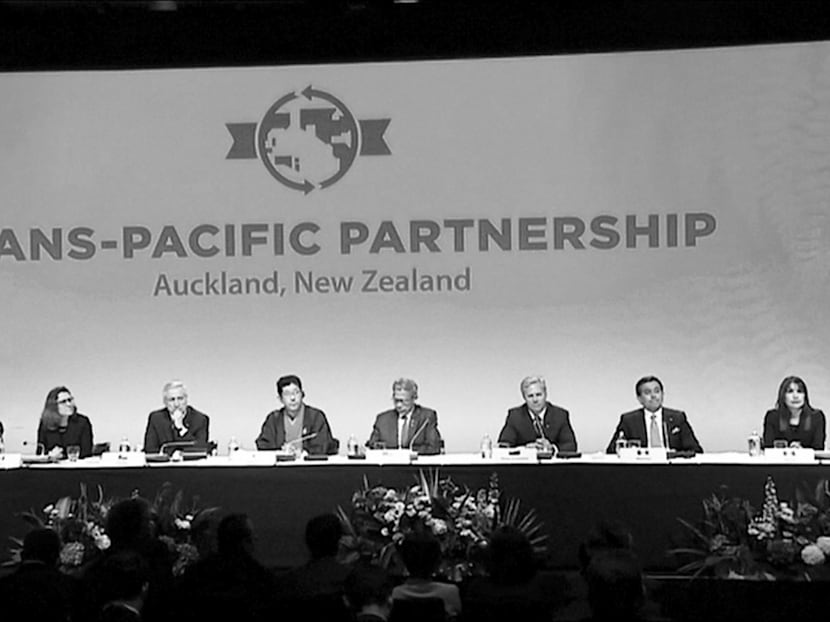
Trade ministers and officials from the 12 Trans-Pacific Partnership (TPP) member nations at the signing ceremony in Auckland. If the TPP is not ratified, this failure of American domestic politics will reverberate through Asia at a time when China is actively seeking to replace the US as the regional hegemon. Photo: Reuters


When the history of the decline of American power is written, the debacle of the Trans-Pacific Partnership (TPP) may not deserve an entire chapter, but it will definitely be more than a footnote.
The TPP is a trade agreement covering 12 countries in the Pacific with a collective population of about 800 million, nearly two-thirds more than that of the European Union single market, and a 40 per cent share of world trade. It has also become one of the most important tests of American leadership in Asia and the world.
Unfortunately, the two main presidential candidates are competing to see which of them hates the TPP more, President Barack Obama is unable to push anything through Congress, and so the chances of it being ratified by the United States are fading fast.
If it is not ratified, this failure of American domestic politics will reverberate through Asia at a time when China is actively seeking to replace the US as the regional hegemon.





China was pointedly left out of the agreement, despite being a Pacific nation and the world’s biggest goods trader. Seen from Beijing, the impending failure of the TPP is a joyous, if baffling, occasion.
It is the latest example — Brexit being another — of the dangers of popular democracy, proving that a country should never leave questions of national interest in the hands of the uninterested and uninformed masses. China’s leaders are no doubt wondering what sort of superpower allows a minority of voters in rust-belt swing states to damage the interests of the entire nation in such an obvious way.
Part of the problem is mixed messaging from the Obama administration. While the TPP has been described informally as the “anybody-but-China club” and an “economic Nato”, the US has been at pains to deny in public that it has anything to do with containing Beijing.
This has forced the administration to try to sell the TPP at home as just another trade deal at a time when many are suspicious of such deals.
The closest Mr Obama has come to revealing the real rationale behind the TPP — the one that might have a better chance of convincing the American public — was in January last year. “China wants to write the rules for the world’s fastest-growing region,” he said. “That would put our workers and our businesses at a disadvantage. Why would we let that happen? We should write those rules.”
US Defence Secretary Ashton Carter went further in April last year when he said: “Passing the TPP is as important to me as another aircraft carrier.”
Both of these statements are true, although Mr Carter probably overestimated the value of his aircraft carriers. By failing to adopt the TPP, the US will in effect cede the right to set trade and economic rules in the world’s fastest-growing region.
In the words of a senior Japanese diplomat, this will hand Beijing a “golden opportunity to establish a trade system in Asia under Chinese leadership”.
Even Japan, which considers the rise of an aggressive China to be its number one existential threat, is considering joining the China-favoured Regional Comprehensive Economic Partnership if the US fails to ratify the TPP. That agreement would cover the 10 nations of the Association of South-east Asian Nations, plus Australia, New Zealand, China, India, Japan and South Korea.
Not only would that regional partnership exclude the US, but it would also include worse safeguards for intellectual property, Internet freedom, workers’ rights, wildlife and the environment.
In these areas and from the perspective of American corporations, the TPP is the “gold standard”, as Mrs Hillary Clinton described it when she was a member of the Obama administration.
With its disdain for Internet freedom, human rights and environmental protection, and its practice of turning a blind eye to malfeasance where it does business abroad, you can be sure Beijing will not push for such standards in any trade agreements.
Some observers in the US and Asia are optimistic that Mrs Clinton, if elected, will revive the TPP under another name. But that would take a long time, and by then the deal will probably be dead.
In the meantime, China will push hard for alternatives that exclude the US. The best chance for America to curb the erosion of its influence and prestige in Asia is for Mr Obama and Congress to force the agreement through in the lame-duck session after the election in November and before the inauguration of the new president in January.
If this does not happen, the US will have shot itself in the foot, ceded enormous influence to China and ensured that future trade deals are much worse for American companies, for workers and for the planet. FINANCIAL TIMES
ABOUT THE AUTHOR:
Jamil Anderlini is Asia Editor of the Financial Times.




