CNA Explains: Why Russia’s nuclear-capable hypersonic Oreshnik missile is drawing attention in the Ukraine war
For the third time in its war on Ukraine, Russia on Sunday (May 24) fired its Oreshnik missile, which Putin has said could be as devastating as a nuclear strike even when fitted with conventional warheads.
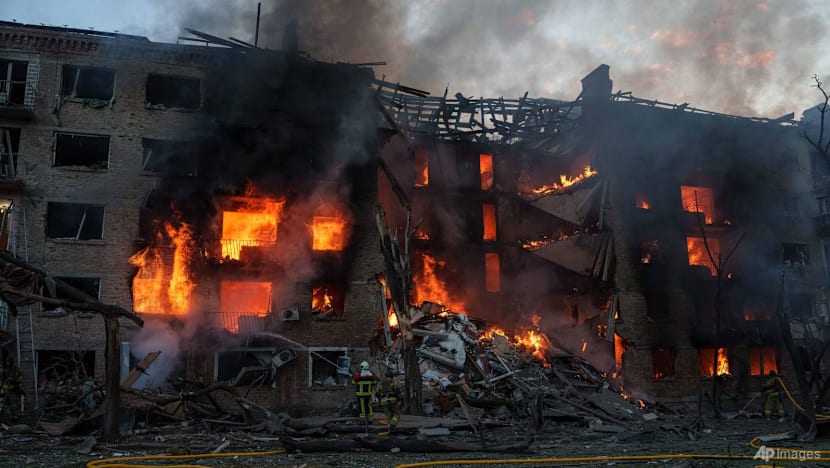
Rescue workers try to put out a fire at a residential building after a Russian strike on Kyiv, Ukraine, on May 24, 2026. (Photo: AP/Evgeniy Maloletka)

This audio is generated by an AI tool.


Russia on Sunday (May 24) launched what Ukrainian officials said was a nuclear-capable hypersonic Oreshnik missile in one of its largest aerial barrages on Kyiv since the war began.
It is the third reported use of the intermediate-range ballistic missile in Ukraine since 2024, underscoring Moscow’s growing willingness to deploy its most powerful experimental weapons in the conflict.
While Russia has used an assortment of missiles throughout its more than four-year war, military analysts said none have the same range, speed and destructive potential as the Oreshnik.
Here's what we know about the weapon, and why it is significant.
What is the Oreshnik?





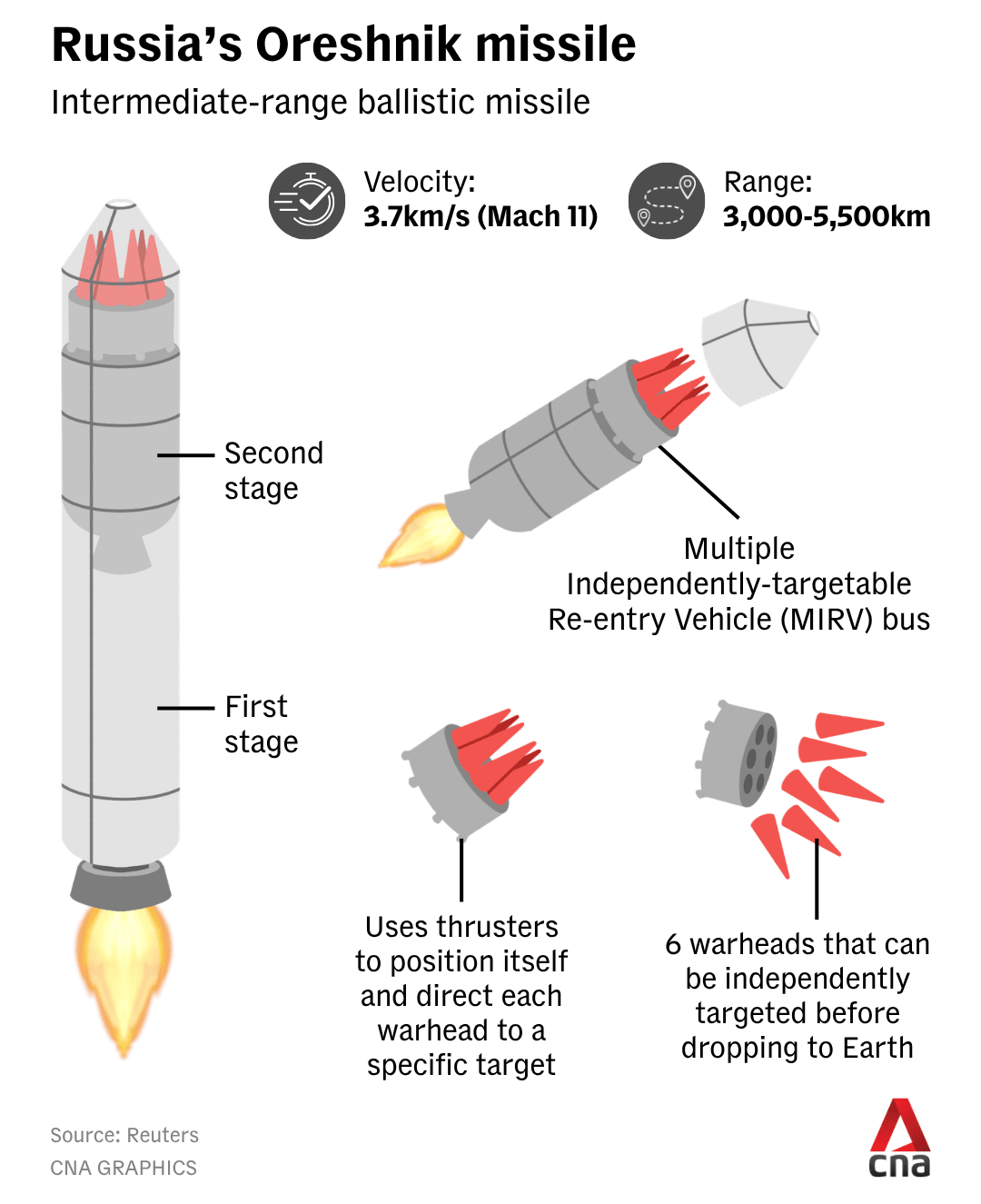
The Oreshnik, named after the Russian word for hazel tree, is an intermediate-range ballistic missile (IRBM), meaning it can strike targets roughly 3,000km to 5,500km away. This puts all of Europe within range.
Ukrainian military officials said in 2024 that the missile can reach speeds of up to Mach 11 (about 13,580kmh), or 11 times the speed of sound.
Russian state media has claimed that the missile could take just 11 minutes to reach an air base in Poland and 17 minutes to reach NATO’s headquarters in Brussels.
According to the Kremlin, the Oreshnik is a "state-of-the-art" weapon that cannot be intercepted.
Russia’s President Vladimir Putin said in 2024 that the missile's destructive elements could reach a temperature close to the surface of the sun.
"Therefore, everything in the epicentre of the explosion breaks up into fractions, into elementary particles, essentially into dust," he said.
Most significantly, military experts said the Oreshnik could be equipped to carry nuclear warheads.
The US defence department has described Oreshnik as an "experimental" IRBM, believed to be derived from Russia’s RS-26 Rubezh intercontinental ballistic missile.
Why is it considered so powerful?
Experts said Oreshnik’s significance lies in its combination of speed, range and warhead design.
It is a Multiple Independently Targetable Re-entry Vehicle (MIRV) system, meaning each warhead can split and hit different targets in a single strike footprint.
In the case of the Oreshnik, Ukraine’s military intelligence has said the missile has six warheads, each carrying six submunitions. This means it could deliver up to 36 separate strikes across a target area, said Dr Nah Liang Tuang, research fellow at the S Rajaratnam School of International Studies (RSIS).
This makes it "very destructive" even without nuclear payloads, he said.
"Even if each warhead was only conventional high explosive, many targets can potentially be gutted, making it a ‘one air raid’ missile," Dr Nah explained.
"Worse still, the Oreshnik arrives at faster than hypersonic speeds, making interception extremely difficult or impossible given the anti-ballistic missile capabilities Ukraine currently has."
Putin has claimed that the Oreshnik is capable of destroying even underground bunkers “three, four or more floors down”, and is immune to any missile defence system.
How does it compare with other Russian missiles?
Apart from the Oreshnik, Russia has also used the hypersonic Kinzhal air-launched ballistic missile for particularly important targets.
Its high speed (up to Mach 10) and ability to manoeuvre in flight help it evade air defences, although Ukraine claims to have shot down a few of them.
Oreshnik is said to be more difficult to intercept than Kinzhal.
Still, some experts said that while the missile can travel at hypersonic speeds, it cannot be manoeuvred in the same way as typical hypersonic missiles.
"As with other intermediate and intercontinental ballistic missiles, its warheads enter the atmosphere and reach their targets at hypersonic speeds," Marcin Andrzej Piotrowski, analyst at the Polish Institute of International Affairs (PISM), said in 2024.
"But unlike the hypersonic weapons, Oreshnik's warheads did not perform any manoeuvres at hypersonic speeds, which would complicate the operation of anti-missile defences," he added.
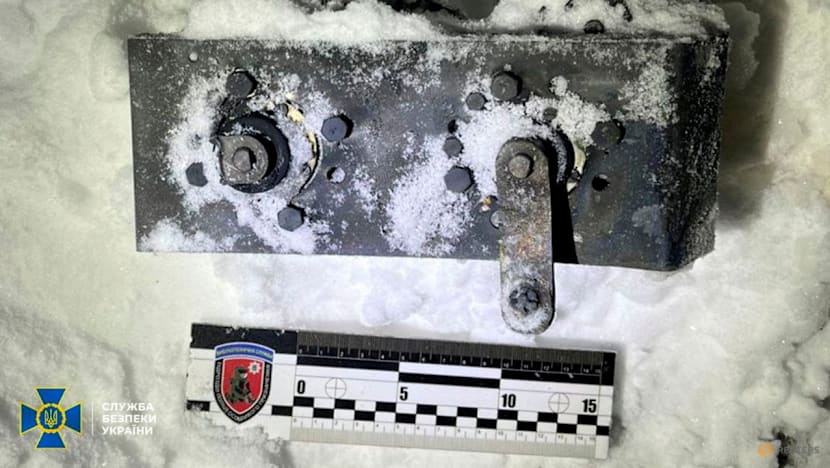
What damage has the Oreshnik caused?
The Oreshnik has been used without a nuclear warhead in all three strikes on Ukraine so far.
The first strike was in Dnipro in 2024 with limited visible damage, suggesting that it had been equipped with dummy warheads.
AFP saw a building roof blown off and scorched trees, while residents reported a "hellish noise" and bright bursts of light.
In January this year, the missile hit a major gas depot in the Lviv region in western Ukraine, local officials said.
During Sunday’s strike in the Kyiv region, which also involved drones and other missiles, four people were killed. Rescue workers were extinguishing fires and sifting through debris of heavily damaged buildings, including houses, shopping centres, museums, theatres, schools and universities.
A Ukrainian resident recounted the ceiling in the metro "crumbling" after residents took shelter underground.

Why Oreshnik matters beyond Ukraine
Unlike most Russian battlefield weapons, Oreshnik’s range places all of Europe within striking distance, including US bases on the continent.
That makes it a new instrument of escalation, giving Moscow the ability to threaten strategic targets without formally resorting to nuclear weapons.
At the same time, experts said there is no way to determine whether an incoming Oreshnik missile carries a nuclear or conventional payload until impact, heightening uncertainty in any scenario of further escalation.
Analysts said the use of the Oreshnik is as much a psychological weapon as a battlefield one.
It reflects “classic sabre rattling”, Dr Nah said, referring to overtly threatening actions intended to intimidate the enemy.
By deploying it, Moscow is signalling it is willing to escalate strikes deep into Ukraine using conventional warheads that mimic nuclear-level destructive potential.
Putin may also be suggesting that the European Union should abandon Ukraine before he uses the missile on them, or for a nuclear strike on Ukraine, Dr Nah added.
He noted that with Russia facing setbacks on the battlefield and a weakening economy, the country faces no chance or “very low” chances of winning the war in Ukraine.
“Moscow is quite frankly, out of options,” Dr Nah said.


Want an issue or topic explained? Email us at digitalnews [at] mediacorp.com.sg. Your question might become a story on our site.