Japan’s Takaichi strengthens US ties, sidesteps pressure in Trump talks: Analysts
The meeting appeared carefully choreographed to avoid open disagreements – apart from a brief awkward moment when Trump made a joke about Pearl Harbor.

This audio is generated by an AI tool.


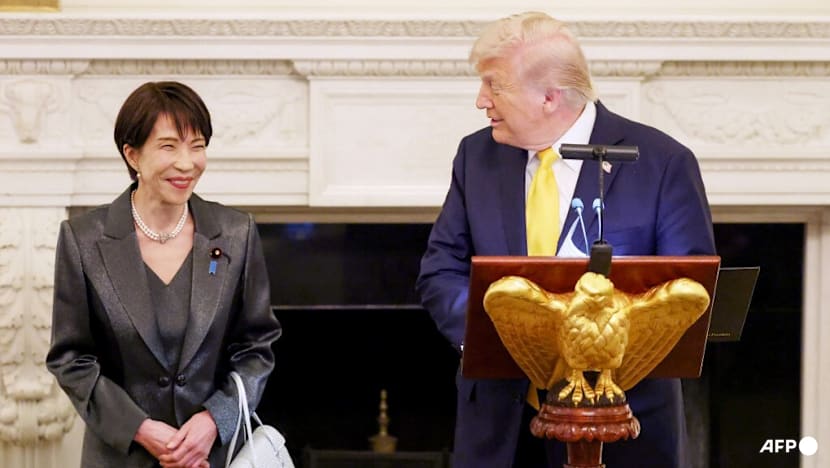
Japan’s Prime Minister Sanae Takaichi struck a careful balance in her White House meeting with United States President Donald Trump on Thursday (Mar 19), sidestepping public pressure over military support in the Middle East while reinforcing the US-Japan alliance, said observers.
Days after urging allies, including Japan, to help secure the Strait of Hormuz amid the US-Israeli war on Iran, Trump spoke positively about Tokyo's efforts related to the Middle East conflict in vague terms.
He gave little indication of what Japan might contribute to securing the vital waterway, but adopted a more cordial tone with Takaichi than in recent remarks criticising allies for holding back.
“Overall, I think that the meeting went as well as could be expected from the Japanese side,” said Glen S Fukushima, a visiting fellow at Stanford University.





“There was real concern, especially in Japan, that (Trump) would bring up the issue of the Japanese sending military support for the Strait of Hormuz. That didn't really come up,” he told CNA’s Asia First.
“Therefore, Takaichi was able to focus on the importance of the US-Japan alliance, and also the importance of economic security and the cooperation between the two countries.”
AWKWARD MOMENT ASIDE
The meeting, which included a 30-minute public session followed by a 90-minute closed-door discussion, appeared carefully choreographed to avoid open disagreements – apart from a brief awkward moment when Trump made a joke about Pearl Harbor while seated next to the Japanese prime minister in the Oval Office.
The remark came in response to a Japanese reporter who asked why allies had not been informed ahead of the strikes on Iran. Touching on the surprise, Trump referenced Japan's attack on the US Pacific fleet in Pearl Harbor on Dec 7, 1941, which prompted the US to enter World War II.
However, experts said they would not read too much into the remark.
“We should not mix that comment up with the underlying strengths of the relationship,” said politics and international studies professor Stephen Nagy from the International Christian University.
“Trump's comments, like many things, I don't think we can take them so seriously, because he uses words so loosely,” he told CNA938.
“(He) says many things that (appear) very consequential and have deep meaning for us. But for him, it's just a metaphor for whatever he wants to talk about.”
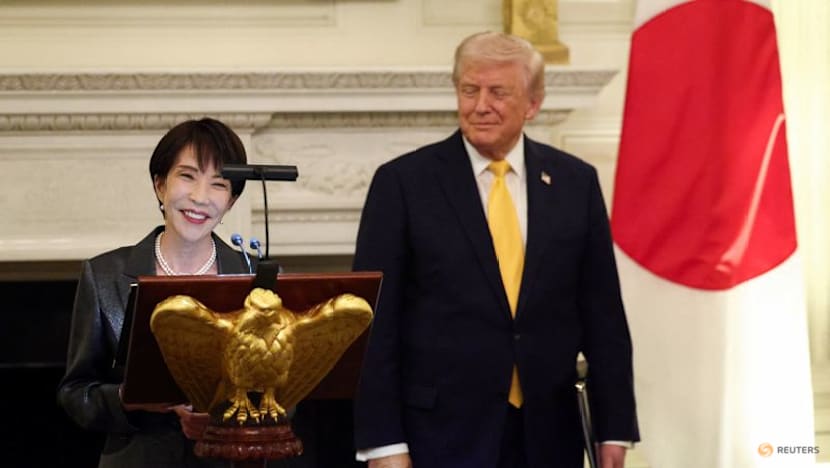
During the public meeting, Takaichi lauded Trump as the only person “who can achieve peace across the world”. Trump also praised Takaichi as a popular and powerful woman following her party’s landslide victory in Japan’s election.
TENSIONS KEPT PRIVATE
While both leaders exchanged pleasantries in front of the cameras, more contentious issues were likely confined to closed-door talks, said analysts.
“I think the Japanese side tried very hard and were successful in minimising the risks and kind of containing any differences to the private meeting,” said Stanford University’s Fukushima.
“For these summit meetings, there's a tremendous amount of preparation done in advance. During the three, four weeks leading up to the meeting, there were just constant meetings taking place between the Japanese and US governments,” he added.
Yet recent developments, particularly the Middle East conflict, have changed the dynamics of the talks.
While details of what was discussed during the private session remain unclear, analysts believe Japan is more likely to contribute to the conflict with Iran through diplomatic efforts.
Japan could “use their diplomatic hat to try and push this conflict to a position where a dialogue and a path towards some kind of peace agreement is possible”, said Nagy of the International Christian University.
BALANCING CHINA TIES
For Tokyo, one of the key objectives of Thursday’s meeting was to reaffirm its security alliance with Washington, especially ahead of a much-anticipated summit between Trump and his Chinese counterpart Xi Jinping, originally slated for the end of March.
Trump has since postponed his scheduled trip to Beijing due to the ongoing war with Iran.
Pointing out that Japan enjoys a strong economic relationship with Beijing, Nagy stressed that Tokyo has no interest in straining ties with China.
Yet Japan remains dependent on the US, he noted, adding that Tokyo “has no other significant partner to balance its relationship with China”.
Fukushima said the meeting signals to China that the US and Japan “are in lockstep cooperation”.
He also highlighted Japan’s focus on strengthening economic cooperation, particularly around Tokyo's planned US-bound US$550 billion investment agreement reached last year as part of a deal to lower tariffs.
Fukushima noted that both leaders had strong domestic incentives to present the meeting as a success – Trump ahead of midterm elections, and Takaichi seeking to demonstrate her ability to manage ties with Washington “despite (Trump’s) somewhat unpredictable statements and actions”.
“The outward appearance right now is that the US-Japan alliance remains firm, and there is no public indication of any rupture,” he added.
Looking ahead, Nagy said Japan’s next steps will be closely watched by other middle powers seeking to balance ties with Washington and Beijing.