From barbecue diplomacy to AI deals: Five takeaways from Nvidia CEO Jensen Huang’s Asia tour
Even as fans trailed him through Taipei and Seoul, Jensen Huang's visit revealed something more consequential - a glimpse into Nvidia's plans to stay on top of the global AI economy.
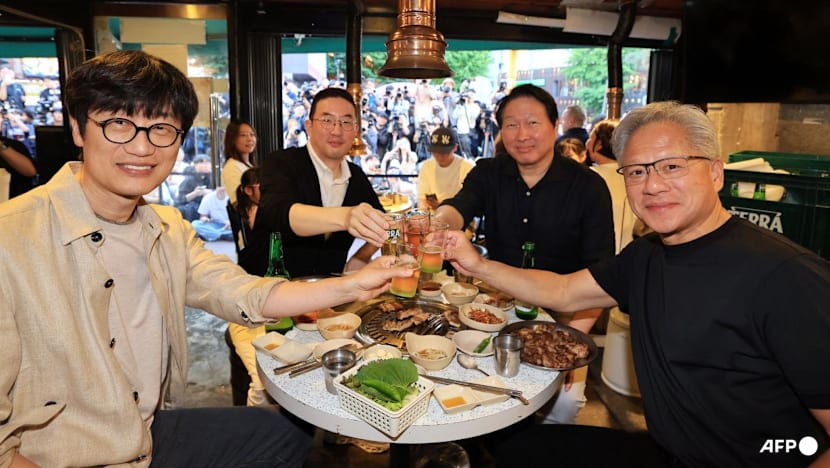
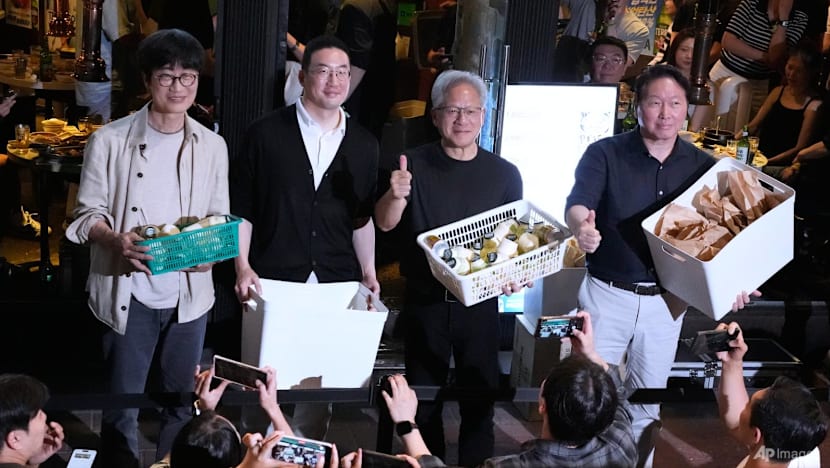
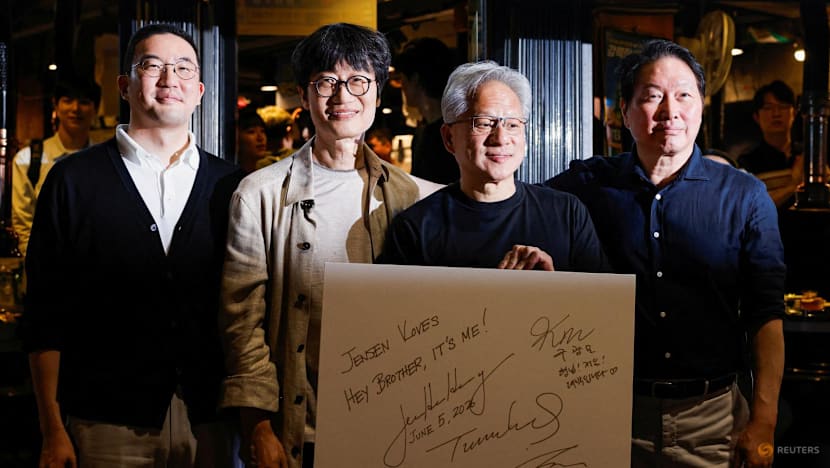
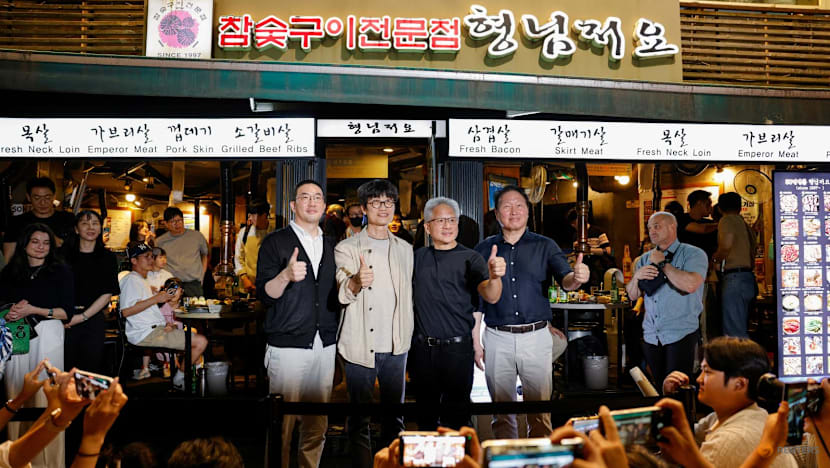
From right: Nvidia CEO Jensen Huang raises a toast with SK Group Chairman Chey Tae-won, LG Group Chairman Koo Kwang-mo and Naver founder and chairman Lee Hae-jin during a dinner at a Korean barbecue restaurant in Seoul on Jun 5, 2026. (Photo: Pool via AFP)

This audio is generated by an AI tool.


SINGAPORE: For three weeks, Jensen Huang has been hard to miss.
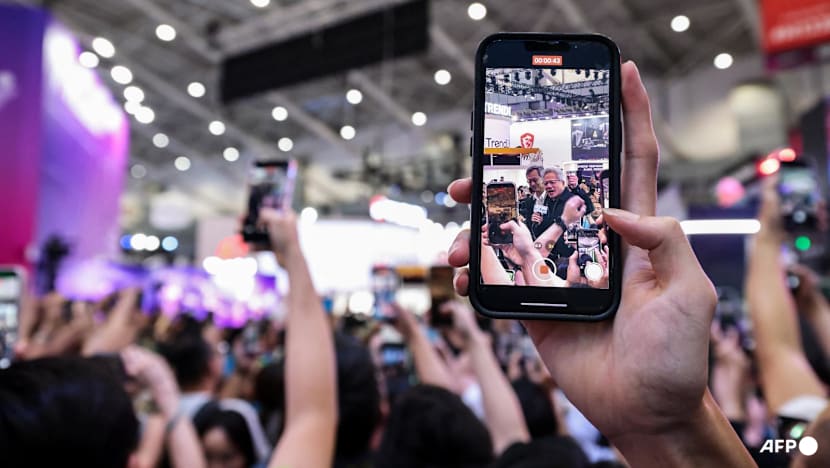
From late-night Korean barbecue dinners to baseball pitches and packed keynote halls, the Nvidia CEO’s swing through China, Taiwan and South Korea drew crowds more akin to a pop star than a tech executive.
But beneath the buzz, the trip revealed something more consequential - a glimpse into how Nvidia plans to entrench itself at the heart of the global artificial intelligence economy.
As his visit draws to a close on Monday (Jun 8), CNA looks at five takeaways from Huang's Asia tour - and what they signal for the company's next moves.





NAVIGATING US-CHINA TENSIONS
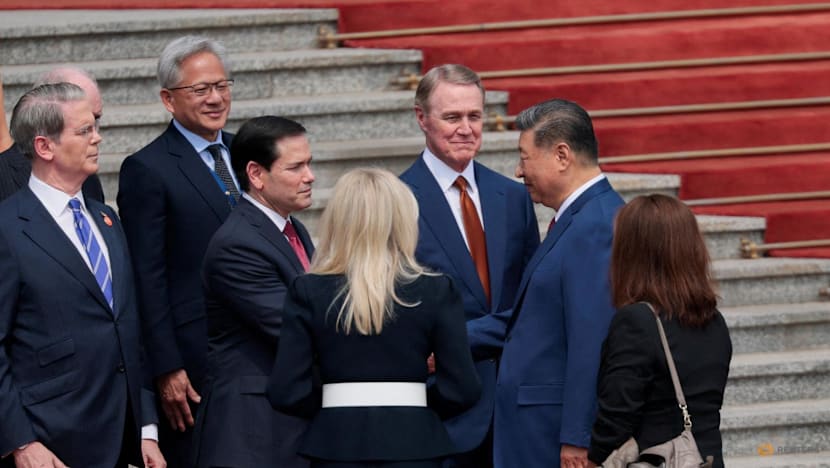
Huang's trip began with a delicate balancing act, as a last-minute addition to a delegation accompanying United States President Donald Trump to China.
In Beijing, he found himself at the centre of ongoing tensions between Washington and Beijing over advanced technology.
While US export controls continue to limit what Nvidia can sell into China, Huang struck a conciliatory tone, arguing that the world’s two largest economies should cooperate in AI rather than compete.
The reality, however, is far more constrained.
China remains too large a market to ignore, and long-term exclusion risks accelerating the rise of Chinese competitors in hardware and software, said Lin William Cong, president’s chair professor of Finance, Computing and Data Science at Nanyang Technological University.
“On the other side, Nvidia must comply with US export controls and maintain trust with Washington, allies and strategic suppliers,” he added.
“That creates a narrow corridor for Nvidia’s China strategy.”
That tension is already shaping Nvidia’s strategy. If access to China is uncertain, then other parts of Asia, particularly Taiwan and South Korea, become even more critical.
“They are more critical not because geopolitical risk disappears there, but because the number of trusted, technologically advanced nodes in the global AI supply chain becomes smaller,” Dr Cong told CNA.
He believes Nvidia’s Asia strategy is a combination of its need for capacity, resilience and options.
The company needs more capacity to meet AI demand and requires trusted partners to navigate export controls and national security constraints.
“And it needs optionality because the rules of the US-China technology relationship can change quickly,” Dr Cong added.
South Korea and Taiwan are indispensable to the current AI supply chain and are deeply embedded in the US-led technology ecosystem.
However, their importance also poses a concentration risk to Nvidia, said Dr Cong. “They are both Nvidia’s strategic advantage and its strategic vulnerability.”
SOUTH KOREA’S EXPANDING ROLE IN NVIDIA PLANS
If there was one stop where Huang’s visit felt especially consequential, it was Seoul.
Between bites of fried chicken and high-level meetings, Nvidia unveiled a series of deals - from a massive AI data centre project with SK Telecom to a partnership with chipmaker SK Hynix to develop advanced memory components needed to run AI systems.
It also touted new collaborations with tech heavyweights such as Naver, LG Group, Hyundai and Doosan on AI infrastructure research, including robotics and AI-powered manufacturing.
South Korea has long been central to Nvidia’s supply chain, with Samsung Electronics and SK Hynix producing about 70 per cent of the memory chips needed for AI chips like those Huang’s company makes.
But this visit signalled something deeper - an expansion beyond components into full-stack AI infrastructure.
“Nvidia is no longer merely selling chips; it is orchestrating an AI infrastructure stack that runs from wafers, memory, packaging and servers to data centres, software platforms and robotics,” said Dr Cong.
Huang made that ambition explicit, pointing to South Korea’s manufacturing strength as fertile ground for “physical AI” - systems that interact with the real world.
"Because Korea is a manufacturing centre of the world, we can apply the robotics technology, the physical AI technology that we invent here for the industry,” Huang said when he arrived in Seoul.
In that sense, the country is evolving from supplier to testbed.
Huang "needs a manufacturing site for physical AI", Jeff Kim, an analyst at Seoul-based KB Securities, wrote in a research note. "South Korea is emerging as a perfect testbed."
South Korea is also a major Nvidia customer. The company announced last year that it would supply more than 260,000 of its most advanced AI chips to the government and some of the country's biggest businesses.
REINVENTING COMPUTERS?
In Taipei, Huang turned his attention to a more personal frontier - the computer itself.
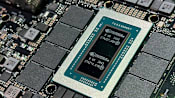
During his keynote address before the Computex technology show in Taipei, he unveiled a new chip that would put AI capabilities directly in PCs.
"This reinvention of the computer is as big of a deal as the reinvention of the phone into what we now know as the smartphone," he said.
The move is both bold and risky.
On one hand, it opens a new market for Nvidia. On the other, it thrusts the company into a fiercely competitive space long dominated by the likes of Intel and AMD, said Stephen Wu, a former AI software engineer and founder of the Carthage Capital investment fund.
Strategically, the push is about more than hardware.
By embedding AI into everyday PCs, Nvidia is betting it can pull developers into its ecosystem, and in turn, drive greater demand for its data centre GPUs.
GPUs are specialised chips originally designed to render gaming graphics at high speed, which have more recently become the engine for chatbots and other AI tools.
PUSHING BACK ON AI JOBS NARRATIVE
Throughout the trip, Huang addressed the growing anxiety that AI would replace human workers.
His response was characteristically blunt.
Calling the link between AI and layoffs “lazy”, he argued that the technology would ultimately create more jobs, not fewer - and that companies would expand as they become more productive.
"How is it possible that AI became productive and useful only six months ago, and they were somehow laying people off two years ago because of AI? It doesn't make any sense,” he told CNA.
The real risk, he suggested, is not AI itself, but failing to adapt to it.
"You're not going to lose your jobs to AI, you're going to lose your job to somebody who learned AI better than you,” the Nvidia CEO said.
For Huang, a future with AI is an optimistic one.
"It's more likely that the companies with ambition will be more productive; they will do things faster, their company will increase in velocity,” he said.
“As a result, they become larger, more profitable. When they become larger, more profitable, they'll end up hiring more people.”
JENSANITY STRIKES AGAIN
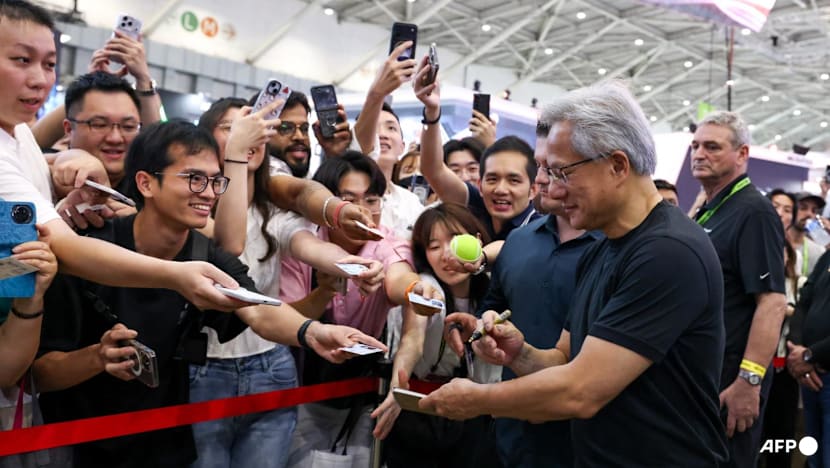
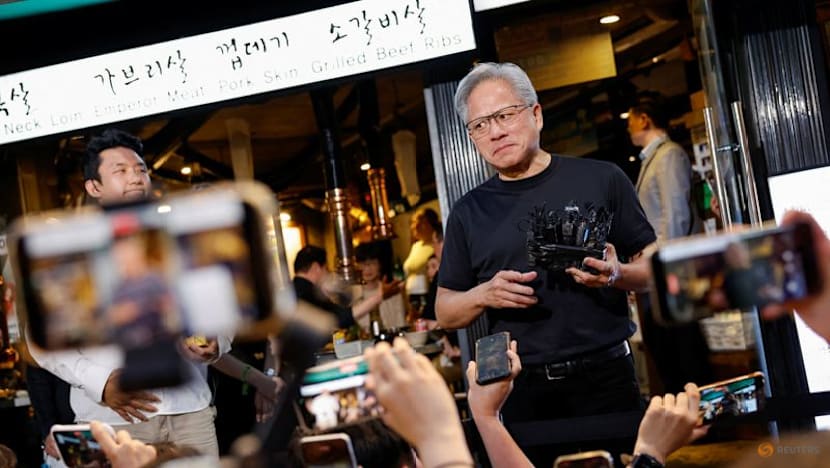
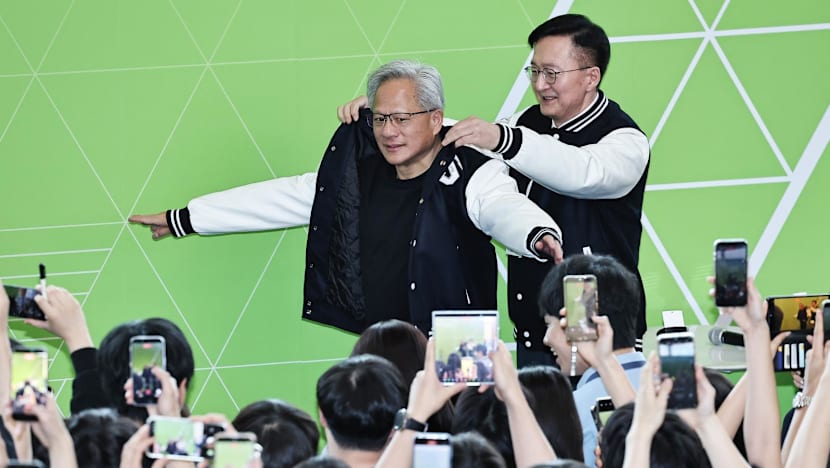
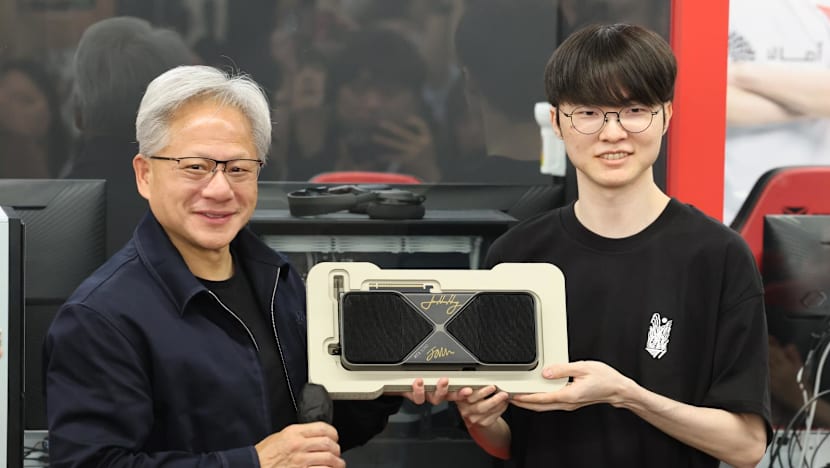
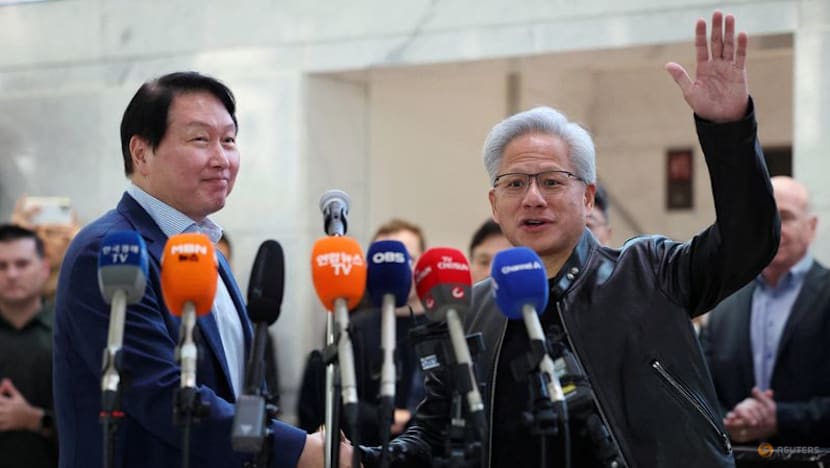
Everywhere Huang went, attention followed in what's been dubbed "Jensanity".
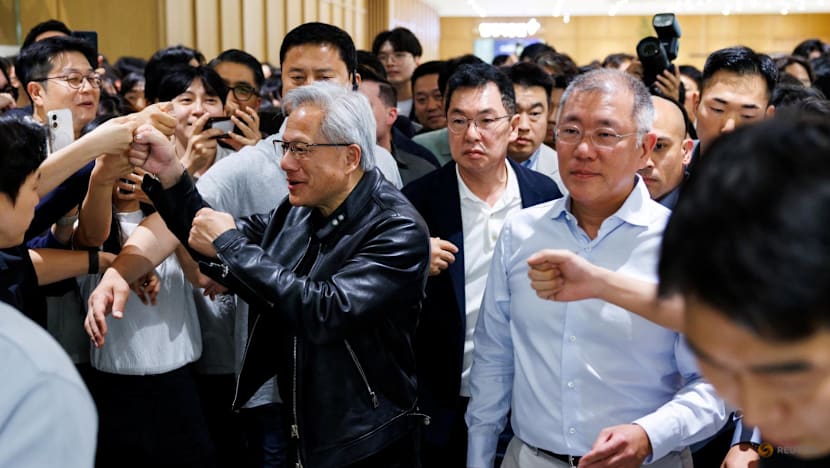
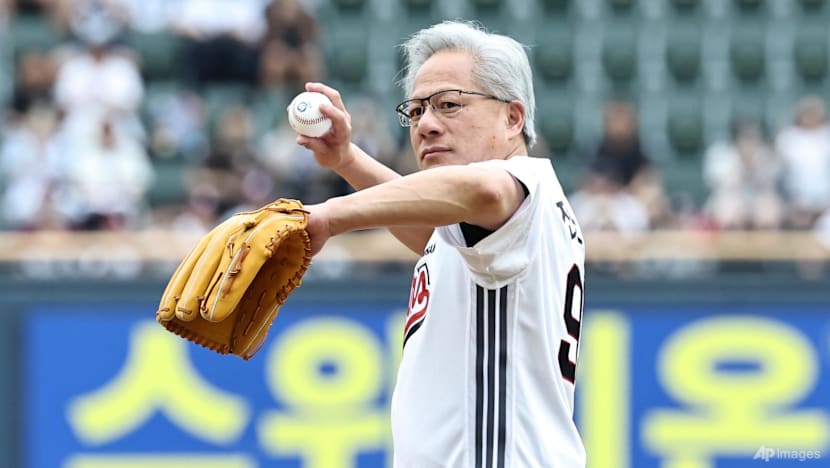
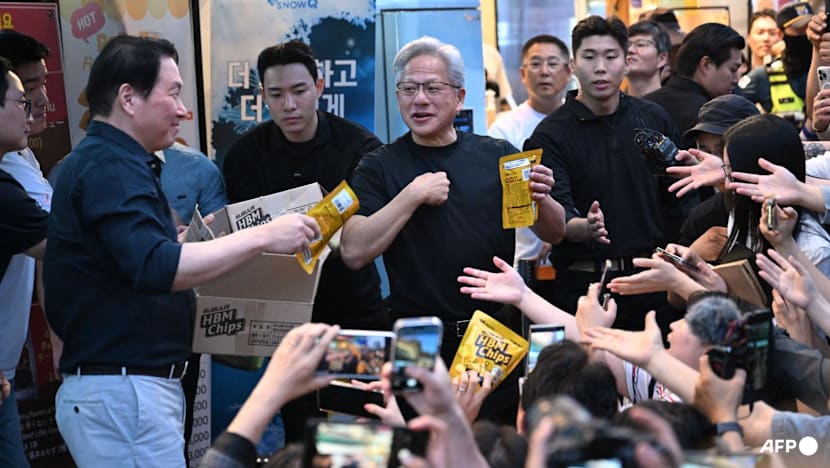
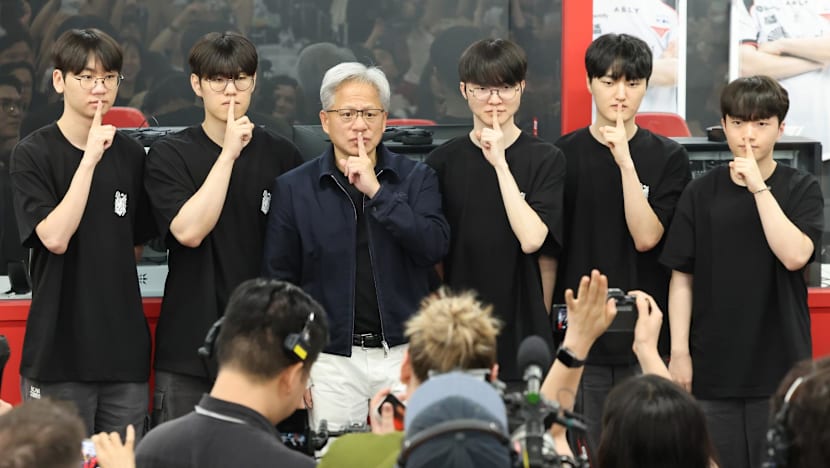
Fans trailed him through Taipei, and huge interest surrounded his public appearances in Seoul - from a talk show cameo to throwing the first pitch at a baseball game.
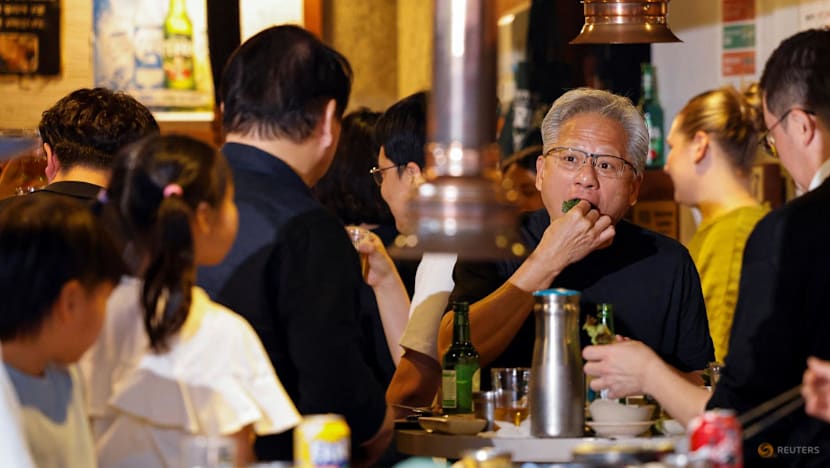
In the South Korean capital, for instance, hundreds gathered outside a restaurant where he shared Korean barbecue and drinks with several business chiefs.

Part of that appeal lies in his story - a Taiwan-born immigrant who built one of the world’s most valuable companies.
Part of it is style - the leather jacket, the easy mix of boardroom strategy and street-level engagement.
“The leather jacket, night markets, fried chicken dinners, baseball appearances and local-language cultural references are not trivial. They turn a supply-chain relationship into a public story,” Dr Cong noted.
But there is also something more strategic at play.
Unlike many tech CEOs, Huang publicly credits suppliers, engineers and local ecosystems as well, making partners feel seen, Dr Cong added.
That matters in a world where chips are no longer just components, but geopolitical assets.
And while his celebrity status draws the spotlight, the fundamentals remain the real story.
“Nvidia is not valuable simply because Jensen Huang is charismatic,” Dr Cong said.
“Its deeper advantages are hardware-software co-design, compute unified device architecture, developer lock-in, an extraordinary product cadence and very deep supply-chain relationships.”